Latest Blog

19% of Patients with a Medicare-Reimbursed Off the Shelf Device Later Receive a Custom Device

New analysis from Dobson DaVanzo: 19% of patients with a Medicare-reimbursed Off the Shelf device later receive a custom-fitted or custom-fabricated orthotic device

Medicare’s own data shows that frequently patients who receive a Medicare-reimbursed OTS device subsequently also receive a Medicare-reimbursed custom-fitted or custom-fabricated orthotic device. Clearly, some modest portion of these data reflect instances in which OTS devices are fitted out of necessity in the acute or emergent setting and occasionally with the knowledge that a custom-fitted or custom-fabricated orthotic device will be required further down the road. There are also instances with progressive disorders where an OTS device may be sufficient for a period of time before their condition warrants a custom-fitted or custom-fabricated orthotic device. Clinical experience indicates that such instances could account for a relatively small portion of the 19%. But it also appears likely that there is a very significant percentage of cases where OTS devices do not fully or appropriately meet the patients’ needs.

Type Total Patients RECEIVED OTS AS FIRST ORTHOTIC DEVICE SUBSEQUENTLY RECEIVED CUSTOM FITTED/FABRICATED DEVICE
Patients Percent of Total Patients Patients Percent of OTS Patients
TLSOs 20,408 1,519 7.4% 163 10.7%
LSOs 197,906 19,917 10.1% 3,372 16.9%
AFOs 268,232 56,959 21.2% 11,359 19.9%
Total 486,546 78,395 16.1% 14,894 19.0%

Source: Dobson-DaVanzo analysis of custom cohort Standard Analytic Files (2007-2010) for Medicare beneficiaries who received O&P services from January 1, 2008 through December 31, 2008.

It appears that delivering substantial numbers of OTS devices without any accompanying adjustment and clinical care may not result in patients getting better, but results, at least in a substantial number of instances, in wasted Medicare funds on that OTS device AND a delay in the patient receiving any improvement in their symptoms/ health. In this unfortunate reality, both the patient and the Medicare program will be negatively impacted as a result of increase patient co-payments and additional expenses to the Medicare program, and a disregard for patient health for Medicare beneficiaries as a result of CMS mandating that devices be provided to patients without professional adjustment and fitting, contrary to the premises for FDA-approved labeling.

Many AOPA Concerns Included in Ways and Means Committee Draft Bill Addressing Medicare Fraud, RACs, and ALJ Delays

AOPA has been anticipating that the House Ways & Means Committee will be putting forward a bill to address Medicare fraud, hospitals, RACs and the long delays for ALJ hearings. Our strategy has involved working closely with two representatives who have been working on their own bills to address RAC problems, Reps. Renee Ellmers (R-NC), author of H.R. 5083: The Medicare DMEPOS Audit Improvement and Reform (AIR) Act of 2014, and Mark Meadows (R-NC), whose bill is still being drafted. Several provisions of great importance to O&P, and language grafted from the O&P Alliance RAC Audit draft legislative language have been recommended by AOPA, with support of our Alliance partners, for inclusion in these two bills. H.R. 5083 includes language to legitimatize the prosthetist/orthotist’s notes as a legitimate part of the medical record and language to require CMS to track specific data on O&P RAC appeals, distinct from the current data spanning indiscriminately ONLY ALL of DMEPOS claims.

The strategy has been that having these provisions appear in bills already crafted by GOP legislators would make it far more likely that these provisions would find their way into the bigger Ways and Means Committee bill, which will be on a faster track for enactment. On Thursday, November 19, Rep. Kevin Brady (R-TX), the Chair of the House Ways and Means Health Subcommittee released a 146-page working draft of his bill. This is the second draft of this bill (AOPA had provided our input on the initial draft just before our Las Vegas meeting).

This draft includes the following provisions of interest/concern to O&P professionals:

• Language to recognize the prosthetist/orthotists’ records and notes as being a legitimate part of the medical record;
• A broad provision instructing CMS to publish the specific requirements they have for payment of lower limb prosthetic claims;
• Instituting a 30-day required ‘discussion period’ between auditor and provider before an audited claim is transmitted to the DME MAC for adjustment or recoupment;
• Language is included to require collection of audit data for O&P distinct from the rest of DME data;
• Two provisions instructing CMS to develop data-driven claims resolution/ settlement offers for Part B claims like O&P, generally paralleling the settlement offers of RACs that CMS has already extended to Part A hospital claims;
• A lengthy provision to initiate a bundled payment system for several specific Medicare episodes of care (surgery and all services 90 days thereafter). While currently limited to: hip/knee joint replacement, lumbar spine fusion, coronary artery bypass graft; heart valve replacement; percutaneous coronary stenting; and colon resection, we are concerned that it would give the Secretary discretion to add additional procedures or services.

Like all legislation, there are things here that we would like, and others that give us great pause. Clearly, the strategy AOPA has invoked to advance some of the provisions we have favored has been borne out, and clearly there is much more work to be done. AOPA will continue working with the Ways & Means staff and legislators sympathetic on O&P issues to try to refine and remedy some of the rough edges with this draft bill. We will keep members apprised of any developments. The 146-page bill may accessed here. Of greatest interest are pages 38-41, 54, 62-63, and 105-133.

New HCPCS Codes for 2015

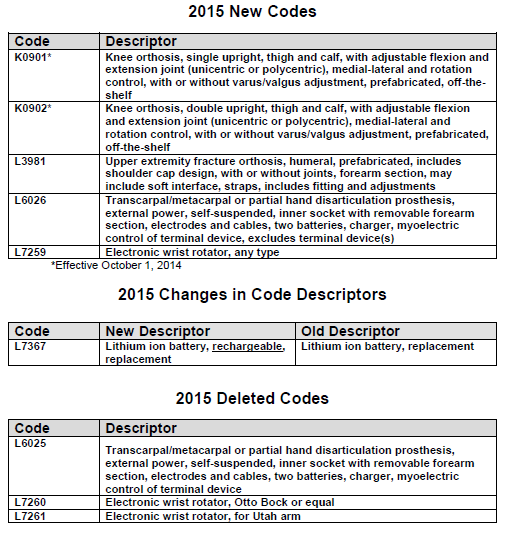
The Centers for Medicare and Medicaid Services (CMS) has released the new HCPCS codes for 2015. There were several changes to the codes that describe orthotics and prosthetics for 2015. Below is a breakdown of the new codes, code descriptor changes and code deletions. All changes are effective for claims with a date of service on or after January 1, 2015.

HCPCS codes 2015

AOPA’s Coding and Reimbursement Committee will review the list of changes and provide appropriate comments to CMS.

Registration is still open for December 10, 2014 at AOPAversity Webinar that will focus on the changes to the HCPCS codes and their potential impact on O&P providers’ as well as reviewing any other upcoming changes which may impact you in 2015. Register for the Webinar.


CMS Issues Final Rule on OTS Orthotics

CMS Reverses Fields, Scuttles Current Process for Redefining Orthotics, and for Limiting Scope of Practice for Certified Orthotic Fitters

Late on Friday afternoon, October 31, CMS released the massive final rule covering end stage renal disease payments and a host of other topics, including its proposal to further amend the regulatory definition of “minimal self-adjustment,” and to redefine the Medicare treatment of off-the-shelf and custom fitted orthotic devices.  After receiving voluminous comments which the agency did not address, CMS simply recited a general synopsis of its July 2 proposal, and then announced what appears to be a deferment, at least for the present, on any final action on the orthotics section of the proposed rule.  Of specific importance is the following statement found on page 445 of the final rule:

 At this time, we have decided not to finalize any changes to the definition of minimal self-adjustment in §414.402 to recognize as an individual with specialized training. We may address this provision in future rulemaking.

 You can read the final rule here.

 AOPA is pleased that, at least in the near-term, our efforts in contesting the CMS proposal on OTS orthotics, and further expansion of the terminology of ‘minimal self-adjustment’ have borne fruit.  Not only would the expanded definition violate the statutory definition but it would likely have expanded the number of OTS devices eligible for competitive bidding.  As noted above, CMS released its final rule relating to the larger rule in which the OTS provisions were embedded, but they announced their decision to defer further action as to minimal self-adjustment, and declined to include any decisions dealing with off-the-shelf, or custom-fitted orthotics.  One of the controversial parts of the proposal was a provision that would have limited certified orthotic fitters to patient care services relating ONLY to off-the-shelf orthotics, and that proposed policy now is not poised to move forward in any identifiable time frame. Similarly, the provisions that would have limited provision of custom-fitted devices by unlicensed, and unaccredited providers, and that would have identified physicians, NPs, therapists and certified orthotists as “persons with expertise” in the area of orthotics have also been dropped from any near-term implementation.

Of course, it is left for all of us to speculate on what prompted CMS to reverse fields and not move forward in the direction they had clearly intended just 4 months ago.

 Was it the sheer volume of the 500+ comments from AOPA members AND their patients?

  • Did the recent Grassley-Harkin letter to CMS Administrator Tavenner force top levels in CMS to apply the brakes?
  • Did the O&P Alliance meeting with CMS Chronic Care Director Laurence Wilson on October 21 help shift the tide?
  • Did data from Medicare’s own records analyzed by AOPA’s consultant, Dobson DaVanzo, showing that 19% of Medicare beneficiaries who receive a Medicare-provided OTS orthotic device, also subsequently receive a Medicare custom-fitted device, give pause to the underlying economic principles of CMS action?

We can only speculate, but we have gained, at least, a reprieve.  That is verygood news, and certainly justifies the energies and resources AOPA, its members and patients invested, as well as what the O&P Alliance and others in the profession have expended in opposing deficient parts of this CMS rule making.

AOPA plans to continue to maintain a high alert on these orthotic issues, hopefully leading to a sounder, more lasting treatment of orthotic devices by the Medicare program.

 Any questions regarding this notice can be directed to Joe McTernan at (571) 431-0811 or JMcTernan@AOPAnet.org.