CMS Issues Press Release on DMEPOS Payment Amounts

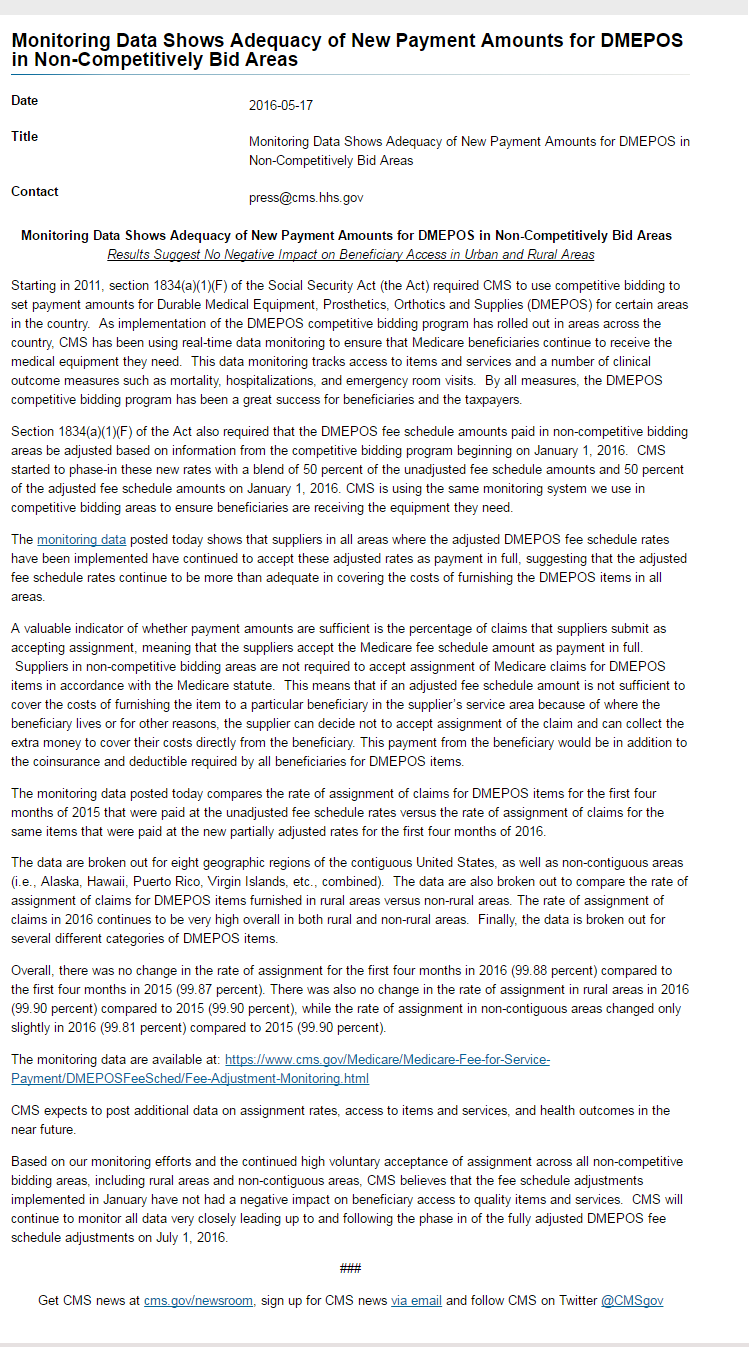
CMS has issued a press release, “Monitoring Data Shows Adequacy of New Payment Amounts for DMEPOS in Non-Competitively Bid Areas”. The content of the CMS Press Release is below.
 The American Orthotic & Prosthetic Association
Wednesday, Apr 01, 2026
On April 25, 2016, the Centers for Medicare and Medicaid Services (CMS), published the annual proposed rule that will govern Medicare coverage of Skilled Nursing Facility (SNF) services through its established Prospective Payment System (PPS). Included in the proposed rule is an opportunity for the public to suggest additions to the list of HCPCS codes that are exempt from the SNF PPS system and therefore, payable by the DME MACs as Medicare Part B services. While most prosthetic services are currently exempt from SNF PPS, there are several codes that have been historically not included in the PPS exempt list and therefore must still be billed to the SNF directly. These include HCPCS codes that describe partial hands and feet as well as L5987 which describes a “shank foot system with vertical loading pylon.” As it has done in the past, AOPA will provide formal comments requesting the inclusion of these codes in the SNF PPS exempt list. AOPA believes that these codes meet the regulatory requirement for SNF PPS exclusion (low volume and high cost) and should be added to the list of HCPCS codes that are exempt from SNF PPS.
Comments on the SNF PPS proposed rule will be accepted until 5 PM EDT on June 20, 2016. Instructions on how to submit comments are included in the proposed rule. Questions regarding this issue may be directed to Joe McTernan at jmcternan@aopanet.org or Devon Bernard at dbernard@aopanet.org.
 The Center for Medicare and Medicaid Services (CMS) has recently issued a revised directive to its contractors handling appeals that are a result of a “complex prepayment reviews, complex postpayment reviews or automated post payment reviews”. CMS has informed the Durable Medical Equipment Medicare Administrative Contractors (DME MACs) and the Qualified Independent Contractor (QIC) that during the redetermination and reconsideration levels they may only “limit their review to the reason(s) the claim or line item at issue was initially denied”.
This means that the contractors may no longer deny your claim for a different reason upon further review of the claim, they may only review and make a decision based on the initial issue at hand. However, this limit doesn’t apply to appeals that are the result of an automated prepayment review denial. The limit on the scope of review only applies to appeals which are the result of denials due to complex prepayment reviews, complex post-payment reviews or automated post payment reviews.
This is a beneficial shift in policy. Previously, the DME MACs and the QIC could still ”develop new issues and evidence at their discretion” and issue unfavorable decisions for any reason besides the one provided with initial determination; even on post-payment reviews. Now, they may only “develop new issues and evidence at their discretion” when a claim is denied on an automated pre-payment review basis only.
This revised directive and instructions only applies to redetermination and reconsideration requests received by the DME MAC or QIC on or after April 18, 2016. The revised instructions will not be applied retroactively. You may view the MLN Matters article which outlines these new directives here.
Questions? Contact Joe McTernan at jmceterna@AOPAnet.org or Devon Bernard at dbernard@AOPAnet.org
WASHINGTON, DC – The American Orthotic & Prosthetic Association (AOPA) wrapped up the 2016 Policy Forum with its first ever O&P Legislation-Writing Congress.
On Tuesday, April 26, former Senator Bob Kerrey led a one of a kind O&P Legislation-Writing Congress, where attendees authored a simple bill that would fix most of the problems that are undercutting the quality of care for orthotic and prosthetic patients who are Medicare beneficiaries.
On Tuesday afternoon, while Policy Forum attendees were learning the ins and outs of a range of government policies and actions, Senator Kerrey had personal meetings with eight Senators to explain the bill, and how some simple steps could rectify the problems and injustices unnecessarily burdening Medicare beneficiaries and the O&P professionals committed to providing care for those patients.
On Wednesday, April 27, 135 O&P providers and patients spent the day on Capitol Hill in more than 400 meetings with their legislators, seeking their support for the new bill and related proposed legislation – the central, indispensable exercise of citizens’ rights that is the core of every AOPA Policy Forum. As AOPA President Jim Campbell, PhD, CO, FAAOP remarked, “What makes this meeting special is that people don’t come to attend, they come to participate”.
Rep. Renee Ellmers (R-NC) was the opening keynote speaker for the Policy Forum, and the audience was provided insight into the Congressional Perspective by Senator Mark Warner (DVA) and Rep. Tammy Duckworth (D-IL). All three legislators shared their own concerns about the proposed LCD and other restraints imposed by CMS that hinder the most advanced and timely patient care.
AOPA would like to thank the 2016 Policy Forum sponsors for making this event possible: WillowWood, Spinal Technology Inc., Ottobock, Becker Orthopedic, Fillauer Companies, Cascade Orthopedic Supply Inc., Townsend Design, Össur Americas Inc., Anatomical Concepts Inc., PEL, Knit-Rite Inc., KISS Technologies, Freedom Innovations, Allard USA, SPS, TRS Inc., Cailor Fleming Insurance, Tamarack Habilitation Technologies, Inc., and Ability Dynamics.
The bill written by Policy Forum attendees, plus photos of the event are all available at Questions? Please contact Lauren Anderson, AOPA’s Manager of Communications, Policy, and Strategic Initiatives at 571/431-0843 or landerson@aopanet.org
Prior to the Policy Forum, AOPA sponsored a press event about the proposed Lower Limb LCD influencing private sector insurers like United and CIGNA, who began denying payment for vacuum pumps reflecting a provision in the flawed and withdrawn LCD Proposal. On Monday, April 25, Rep. Renee Ellmers (R-NC) and Rep. Jan Schakowsky (D-IL) introduced H.R. 5045, a bill that would establish a moratorium on any action on the LCD through Spring 2017 and remove the withdrawn LCD from the CMS and DME MAC websites and establishing that, contrary to some legal interpretations at HHS, CMS indeed can, and is obliged to manage and instruct its contractors, including the DME MACs, what to do across topics including LCD issues.
If CMS cannot accomplish these steps, H.R. 5045, a moratorium on this LCD, needs to be enacted into law to fix this horrendous problem hampering some of our most vulnerable citizens-patients who suffer from either limb loss or chronic limb impairment.
On April 25, Representative Ellmers (R-NC-02) introduced HR 5045: Preserving Access to Modern Prosthetic Limbs Act of 2016. The bill is “to impose a moratorium on the implementation of a proposed Medicare local coverage determination on lower limb prostheses”. The bill places a moratorium until June 30, 2017 on implementing the July 16, 2015 Local Coverage Determination (LCD): Lower Limb Prostheses (DL33787). The bill also would require that CMS and it contractors remove the policy from their websites, which is necessary because private payors (United Health Care and Cigna) have been adopting provisions included in the LCD. This bipartisan bill was co-sponsored by Reps. Blackburn (R-TN-7) and Schakowsy (D-IL-9). This bill will be discussed during the Policy Forum, where AOPA members will request that their representatives become a co-sponsor.
“We Warned Last Year That This Would Turn Back the Clock for America’s Amputees … And It Has.” Portland and Minneapolis Amputees Denied Coverage by United Healthcare Tell Their Story; Cigna Also Criticized for Exploiting Non-Final Medicare Rule.
WASHINGTON, D.C. – A highly controversial Medicare rule proposal to turn back the clock to 1970s-style health care for America’s two million amputees set off a firestorm of protests last summer. Now, the American Orthotic & Prosthetic Association (AOPA) is warning that, as predicted, the Medicare rule is being exploited by private health care insurers to deny coverage to amputees for previously approved medical care and devices.
AOPA said that United Healthcare and Cigna have been identified as using the cover provided by the non-final Medicare rule to deny coverage to amputees. Two amputees from Portland and Minneapolis told reporters today about their experiences with United Healthcare coverage denials. AOPA also produced a February 2016 letter from six groups, including the Amputee Coalition, urging Cigna to reverse a late 2015 coverage statement that is being used by the company to deny coverage to amputees.
In August 2015, the amputee community’s outrage over the proposed Medicare rule boiled over during a public hearing in Baltimore and a subsequent protest outside the Health and Human Services headquarters in Washington, D.C. Amputees also mounted a vigorous #notaluxury social media campaign that culminated in 100,000+ signatures on a White House “We The People” petition. The proposed changes to federal reimbursement for lower limb prosthetic care would create unreasonable and clinically unjustified hurdles to amputees receiving care that is now routinely provided.
AOPA and the Amputee Coalition cautioned last summer that, if not withdrawn, the disputed Medicare rule would be seized upon by private insurers in order to deny coverage to amputees. Among the chief concerns of critics is that the supposed scientific basis for the Medicare rule proposal has been debunked by nine leading researchers who wrote to Medicare that they are “extremely concerned that the [proposed rule to reduce care for amputees] was not based at all on the current literature and science associated with the provision of prosthetic care.”
After facing a firestorm of criticism, the Centers for Medicare & Medicaid Services (CMS) said it would study the rule further, but declined to withdraw it and, in failing to take that step, allowed private insurers to exploit it.
Further compounding the problem is the fact that CMS has continued to handle the draft rule in a secretive and non-transparent fashion. CMS denied a FOIA request asking for the public comments submitted by members of the public about the draft rule. When the draft rule was taken back for further study and review, CMS allowed no clear mechanism for additional public, patient or other stakeholder input to be provided to the committee now handling it. CMS has even gone so far as to decline to even identify the names and titles of the individuals who are handling the review process. All are reported to be government employees, and there is no indication whether there are amputees on this new committee.
Michael Oros, president elect, American Orthotic & Prosthetic Association and CEO, Scheck & Siress, Chicago, IL., said: “We warned last year that this scientifically unjustified Medicare rule would be exploited by insurance companies if it was not withdrawn. We said that this rule would turn back the clock on the quality of care for two million amputees. And it has. It is very difficult to imagine any other aspect of American healthcare where millions of people would be denied available and appropriate treatment and devices that can speed their return to the fullest and most active possible life. Even worse, there is no medical or other justification for these unreasonable and inappropriate hurdles that would amount to a return to a 1970s standard of care.”
Mark Martin, 40, Portland, Oregon, lost his left leg due to an aneurysm that struck him during a workout. He ended up as an above the knee amputee.
Martin said: “I experienced denials from United Healthcare even on my initial preparatory prosthetic. Then, when I advanced to the point of being ready for a definitive prosthetic-capable of letting me run after my three young children, play basketball, and return to a more regular travel schedule for my career with a consulting firm – I was met with wave after wave of denials. These were timed, not coincidentally, after the draft Medicare policy was released. Denial language began to incorporate the draft policy limitations that ran contrary to actual policy provisions.”
Martin added: “I was, recently, fortunate to receive an approval but not before significant resources were brought to bear, and multiple denials were challenged to secure an independent review of my case by a medical professional actually experienced in the issues of amputees. Many, many months passed that I could have been advancing my recovery, returning to my activities and better supporting my family. The only barrier in that time was the lack of an appropriate prosthetic. I know that many people would not have the resources or support to fight this the way I did. Getting needed medical care should not depend on having an amazing employer, dedicated medical professionals, and the personal resources to mount a campaign against an insurance company. The system and this not-even-approved policy stood in the way of my reasonable care, and I know it stands in the way of so many others in my situation.”
Rob Rieckenberg, a 37-year-old amputee from Minneapolis, lost a leg after he was mugged and left on train track where he was struck by a train. He has a vacuum suspension socket and sought continued care through employer-provided group insurance with United Healthcare.
Rieckenberg said: “In the wake of the draft Medicare rule, United Healthcare was going to deny me coverage. So I had to buy an individual plan through Blue Cross. I’m paying five times as much for premiums because United wouldn’t have extended me the coverage I am due. I had to have a vacuum suspension because of the skin grafts on my stump. Any less-advanced technology would tear up my skin.”
Rieckenberg added: “I participated in the summer of 2015 protests in Washington, DC, outside of the Health and Human Services headquarters to protest this attack on amputees. I have been on Capitol Hill this week with the Amputee Coalition to call attention to this injustice. It is unfair to amputees to see coverage denied by insurance companies that are hiding behind a rule that has not even been finalized by Medicare. It’s a bad rule, but it’s even worse when it can lower the care for amputees without even being formally enacted.”
United Healthcare is not alone in using the draft Medicare rule as the basis for denying medical care to amputees. Cigna also proceeded in the same fashion. In a February 10, 2016 letter signed by six groups, including AOPA and the Amputee Coalition, Cigna was urged to immediately rescind a coverage policy denying reimbursements for residual limb volume management and moisture evacuation systems, such as vacuum-assisted socket systems.
The joint letter to Cigna notes: “The technology used in vacuum pump systems for limb prostheses has existed since the mid-1990s. As noted above, Medicare has approved more than 15,000 claims over the last 12 years for these components. The Food and Drug Administration has also approved the manufacture, distribution, and use of this technology, signaling that it vouches for, at minimum, the safety of the components. To counter this evidence and deny amputees access to a clinically-accepted standard of care on the summary conclusion that insufficient clinical evidence exists compromises the medical well-being of individuals with limb loss covered by Cigna. In fact, it suggests the motivation for the new policy may be based primarily on the short term cost-effectiveness denying coverage.”
According to the Amputee Coalition there are roughly two million persons in the U.S. living with limb loss, and there are approximately 185,000 new amputees each year.
On April 21, 2016, AOPA held a press conference call to discuss the impact that CMS’ proposed Lower Limb LCD is having in the private sector. Media participants heard from AOPA President Elect Michael Oros, CPO, FAAOP, Tom Fise of AOPA, and Mark Martin and Rob Rieckenberg, two amputees who have been affected by the new policies. Listen to the audio from the call. The press release summarizing the call is below:
“We Warned Last Year That This Would Turn Back the Clock for America’s Amputees … And It Has.” Portland and Minneapolis Amputees Denied Coverage by United Healthcare Tell Their Story; Cigna Also Criticized for Exploiting Non-Final Medicare Rule.
WASHINGTON, D.C. – April 21, 2016 – A highly controversial Medicare rule proposal to turn back the clock to 1970s-style health care for America’s two million amputees set off a firestorm of protests last summer. Now, the American Orthotic & Prosthetic Association (AOPA) is warning that, as predicted, the Medicare rule is being exploited by private health care insurers to deny coverage to amputees for previously approved medical care and devices.
AOPA said that United Healthcare and Cigna have been identified as using the cover provided by the non-final Medicare rule to deny coverage to amputees. Two amputees from Portland and Minneapolis told reporters today about their experiences with United Healthcare coverage denials. AOPA also produced a February 2016 letter from six groups, including the Amputee Coalition, urging Cigna to reverse a late 2015 coverage statement that is being used by the company to deny coverage to amputees.
In August 2015, the amputee community’s outrage over the proposed Medicare rule boiled over during a public hearing in Baltimore and a subsequent protest outside the Health and Human Services headquarters in Washington, D.C. Amputees also mounted a vigorous #notaluxury social media campaign that culminated in 100,000+ signatures on a White House “We The People” petition. The proposed changes to federal reimbursement for lower limb prosthetic care would create unreasonable and clinically unjustified hurdles to amputees receiving care that is now routinely provided.
AOPA and the Amputee Coalition cautioned last summer that, if not withdrawn, the disputed Medicare rule would be seized upon by private insurers in order to deny coverage to amputees. Among the chief concerns of critics is that the supposed scientific basis for the Medicare rule proposal has been debunked by nine leading researchers who wrote to Medicare that they are “extremely concerned that the [proposed rule to reduce care for amputees] was not based at all on the current literature and science associated with the provision of prosthetic care.”
After facing a firestorm of criticism, the Centers for Medicare & Medicaid Services (CMS) said it would study the rule further, but declined to withdraw it and, in failing to take that step, allowed private insurers to exploit it.
Further compounding the problem is the fact that CMS has continued to handle the draft rule in a secretive and non-transparent fashion. CMS denied a FOIA request asking for the public comments submitted by members of the public about the draft rule. When the draft rule was taken back for further study and review, CMS allowed no clear mechanism for additional public, patient or other stakeholder input to be provided to the committee now handling it. CMS has even gone so far as to decline to even identify the names and titles of the individuals who are handling the review process. All are reported to be government employees, and there is no indication whether there are amputees on this new committee.
Michael Oros, president elect, American Orthotic & Prosthetic Association and CEO, Scheck & Siress, Chicago, IL., said: “We warned last year that this scientifically unjustified Medicare rule would be exploited by insurance companies if it was not withdrawn. We said that this rule would turn back the clock on the quality of care for two million amputees. And it has. It is very difficult to imagine any other aspect of American healthcare where millions of people would be denied available and appropriate treatment and devices that can speed their return to the fullest and most active possible life. Even worse, there is no medical or other justification for these unreasonable and inappropriate hurdles that would amount to a return to a 1970s standard of care.”
Mark Martin, 40, Portland, Oregon, lost his left leg due to an aneurysm that struck him during a workout. He ended up as an above the knee amputee.
Martin said: “I experienced denials from United Healthcare even on my initial preparatory prosthetic. Then, when I advanced to the point of being ready for a definitive prosthetic – capable of letting me run after my three young children, play basketball, and return to a more regular travel schedule for my career with a consulting firm – I was met with wave after wave of denials. These were timed, not coincidentally, after the draft Medicare policy was released. Denial language began to incorporate the draft policy limitations that ran contrary to actual policy provisions.”
Martin added: “I was, recently, fortunate to receive an approval but not before significant resources were brought to bear, and multiple denials were challenged to secure an independent review of my case by a medical professional actually experienced in the issues of amputees. Many, many months passed that I could have been advancing my recovery, returning to my activities and better supporting my family. The only barrier in that time was the lack of an appropriate prosthetic. I know that many people would not have the resources or support to fight this the way I did. Getting needed medical care should not depend on having an amazing employer, dedicated medical professionals, and the personal resources to mount a campaign against an insurance company. The system and this not-even-approved policy stood in the way of my reasonable care, and I know it stands in the way of so many others in my situation.”
Rob Rieckenberg, a 37-year-old amputee from Minneapolis, lost a leg after he was mugged and left on train track where he was struck by a train. He has a vacuum suspension socket and sought continued care through employer-provided group insurance with United Healthcare.
Rieckenberg said: “In the wake of the draft Medicare rule, United Healthcare was going to deny me coverage. So I had to buy an individual plan through Blue Cross. I’m paying five times as much for premiums because United wouldn’t have extended me the coverage I am due. I had to have a vacuum suspension because of the skin grafts on my stump. Any less-advanced technology would tear up my skin.”
Rieckenberg added: “I participated in the summer of 2015 protests in Washington, DC, outside of the Health and Human Services headquarters to protest this attack on amputees. I have been on Capitol Hill this week with the Amputee Coalition to call attention to this injustice. It is unfair to amputees to see coverage denied by insurance companies that are hiding behind a rule that has not even been finalized by Medicare. It’s a bad rule, but it’s even worse when it can lower the care for amputees without even being formally enacted.”
United Healthcare is not alone in using the draft Medicare rule as the basis for denying medical care to amputees. Cigna also proceeded in the same fashion. In a February 10, 2016 letter signed by six groups, including AOPA and the Amputee Coalition, Cigna was urged to immediately rescind a coverage policy denying reimbursements for residual limb volume management and moisture evacuation systems, such as vacuum-assisted socket systems.
The joint letter to Cigna notes: “The technology used in vacuum pump systems for limb prostheses has existed since the mid-1990s. As noted above, Medicare has approved more than 15,000 claims over the last 12 years for these components. The Food and Drug Administration has also approved the manufacture, distribution, and use of this technology, signaling that it vouches for, at minimum, the safety of the components. To counter this evidence and deny amputees access to a clinically-accepted standard of care on the summary conclusion that insufficient clinical evidence exists compromises the medical well-being of individuals with limb loss covered by Cigna. In fact, it suggests the motivation for the new policy may be based primarily on the short term cost-effectiveness of denying coverage.”
According to the Amputee Coalition there are roughly two million persons in the U.S. living with limb loss, and there are approximately 185,000 new amputees each year.
MEDIA CONTACT: Alex Frank, (703) 276-3264 and afrank@hastingsgroup.com.
EDITOR’S NOTE: A streaming audio replay of this news event will be available as of 5 p.m. EDT on April 21, 2016 at https://www.aopanet.org/media/press-releases/.
The American Orthotic & Prosthetic Association is a national trade association committed to providing high quality, unprecedented business services and products to O&P professionals. Since its founding in 1917, AOPA has worked diligently to establish itself as the voice for O&P businesses. Through government relations efforts, AOPA works to raise awareness of the profession and to impact policies that affect the future of the O&P industry. AOPA membership consists of more than 2,000 O&P patient care facilities and suppliers that manufacture, distribute, design, fabricate, fit, and supervise the use of orthoses (orthopedic braces) and prostheses (artificial limbs). Visit AOPA at www.aopanet.org.
Media Coverage
Rehab Management
Pharmacy Choice
HME News
insurancenewsnet.com
Inside O&P
Healio
The Centers for Medicare and Medicaid Services (CMS) has announced that effective April 19, 2016, the interest rate that will be applied to Medicare overpayments and underpayments will be 10.00%, representing an increase of 0.25% since the last quarterly update. Federal regulations require the Medicare interest rate to be adjusted quarterly based on information published by the Treasury Department.
Questions regarding this issue may be directed to Joe McTernan at jmcternan@aopanet.org or Devon Bernard at dbernard@aopanet.org
Update: Just 10 days after the March 28th deadline for submission of comments regarding the Uniform Glossary of Medical Terms, CMS finalized an update to the glossary that included the revision to the definition of the term “orthotics and prosthetics” that were suggested by both AOPA and the O&P Alliance. Both groups suggested that the definition no longer include the term “due to breast cancer” when defining external breast prosthesis as part of the larger definition of the term “orthotics and prosthetics.” AOPA is pleased that its suggested revision was considered and accepted by CMS and the other federal agencies tasked with maintain the Uniform Glossary of medical Terms.
AOPA recently submitted comments applauding the decision to include a separate and distinct definition of the term “Orthotics and Prosthetics” as part of the Uniform Glossary of Medical Terms. This document, which was established through provisions of the Affordable Care Act, is intended to provide guidance to private insurance companies when defining and establishing coverage for essential health benefits.
Recently, the Department of Labor, in conjunction with the Centers for Medicare and Medicaid Services (CMS), requested public comment on the latest revision to the Uniform Glossary of Medical Terms, which, for the first time, included a proposed definition of the term Orthotics and Prosthetics. The Uniform Glossary proposed the following definition, which matched the suggested definition that was submitted for consideration by AOPA and the O&P Alliance as part of their previous comments:
Leg, arm, back, and neck braces, and artificial legs, arms, and eyes, and external breast prostheses incident to mastectomy resulting from breast cancer. These services include: adjustments, repairs, and replacements required because of breakage, wear, loss, or a change in the patient’s physical condition.
AOPA’s comments applauded the decision to include a separate definition of the term Orthotics and Prosthetics as part of the Uniform Glossary and suggested a minor change to eliminate the requirement of breast cancer as the sole cause for mastectomy in the definition of a breast prostheses. AOPA’s suggested revision to the definition reads as follows:
Leg, arm, back, and neck braces, and artificial legs, arms, and eyes, and external breast prostheses incident to mastectomy. These services include: adjustments, repairs, and replacements required because of breakage, wear, loss, or a change in the patient’s physical condition.
AOPA and its partners, such as the O&P Alliance will continue to advocate for fair and equitable treatment of O&P providers. The inclusion of the separate definition of the term orthotics and prosthetics in the Uniform Glossary provides additional distinction of O&P services from the universe of Durable Medical Equipment and represents a significant advancement in acknowledging the unique skill set that properly trained and educated O&P practitioners offer to patients.
AOPA’s comments may be viewed here.
Questions regarding this issue may be directed to Joe McTernan at jmcternan@aopanet.org or Devon Bernard at dbernard@aopanet.org.