Latest Blog

Bipartisan Bill That Would Delay Bundled Payments for Joint Replacements Introduced

On Wednesday, March 23, 2106, Rep. Price (R-GA) and Rep. Scott (D-GA) introduced a bipartisan bill that would delay implementation of a Medicare bundled payment program that would pay hospitals a single payment for joint replacement surgeries and any related follow up care for a period of 90 days post-surgery.  This program, known as the Comprehensive Care for Joint Replacement (CCJR) payment model was finalized in the Federal Register on November 16, 2015 and is scheduled for implementation on April 1, 2016 — despite significant concerns about the payment model that were submitted by various medical groups and allied healthcare groups such as AOPA through the official notice and comment period.

According to Rep. Price, the bipartisan bill seeks to delay implementation of the CCJR program until January 2018.  In an interview, Rep Price stated, “at the very least, a delay in implementation is warranted to give all involved time to better assess, review, and weigh the impact and consequences of this proposal and more adequately prepare so patients are protected.”

AOPA believes a delay in implementation is warranted to allow for more analysis of the potential impact of this payment model on all parties involved, especially patients.  AOPA’s comments on the CCJR payment model may be found here.

AOPA will continue to monitor the progress of this bill and report any information on a potential delay in implementation of the CCJR payment model as it becomes available.

Questions regarding this issue may be directed to Joe McTernan at jmcternan@aopanet.org.

Proof of Delivery Requirements: AOPA’s Efforts Pay Dividends

As you may recall, last year the four Durable Medical Equipment Medicare Administrative Contractors (DME MACs) released a clarification on the type of information which must be included on a valid Proof of Delivery (POD).  The DME MACs stated that the inclusion of the official L-code descriptor, which had been the accepted norm for years, was not sufficient enough and that suppliers/providers had to include narrative descriptions and/or manufacturer information (serial number, part number, model number, manufacturer name, brand name, etc.).  As a result of this sudden shift in policy numerous providers/suppliers began to have their claims denied due to invalid PODs, which were valid prior to the DME MAC clarification.

AOPA challenged the excessive specificity of that new proof of delivery policy and the problems it posed for O&P patient care providers almost immediately and sent a letter to CMS’ Laurence Wilson, Director of Chronic Care Policy Group and Dr. Shantanu Agrawal, CMS’ Deputy Administrator and Director of Center for Program Integrity. AOPA’s letter argued that only FDA received authority from Congress to require serial numbers and other unique device identifiers, and that CMS could not enforce such a ‘de facto’ serial number requirement in the absence of explicit Congressional authority.  AOPA also took the opportunity to address the issue of the new POD requirements with the comments submitted in regard to the Draft Lower Limb Prostheses Policy released in July 2015.

All of this work has paid off, as AOPA has recently learned that CMS has reversed course and will now accept the official L-code descriptors on PODs.  Effective March 4, 2016 the Program Integrity Manual, specifically Chapter 4; Section 4.26.1- Proof of Delivery and Delivery Methods, has been updated and includes the following statement:

The long description of the HCPCS code, for example, may be used as a means to provide a detailed description of the item being delivered; though suppliers are encouraged to include as much information as necessary to adequately describe the delivered item.

You may view the official Change Request published by CMS here and the revised Program Integrity Manual here.

While the complete PIM indicates that “suppliers are encouraged to include as much information as necessary to adequately describe the delivered item,” PODs that include the complete HCPCS code descriptors can no longer be considered invalid resulting in a denial of the claim.

AOPA is very pleased to see a direct result of its communication efforts with top CMS officials regarding POD requirements and will continue to advocate for the equitable treatment of its members.

Questions? Contact Joe McTernan at jmcternan@AOPAnet.org or Devon Bernard at dbernard@AOPAnet.org.

AOPA and the O&P Alliance Meet with CMS Officials about Prosthetic LCD Workgroup

On February 26, AOPA Executive Director Thomas Fise joined other representatives of the O&P Alliance for a meeting with CMS Deputy Administrator/Chief Medical Officer, Patrick Conway, M.D., Kate Goodrich, M.D., the Director of the Center for Clinical Standards & Quality, Susan Miller, M.D. who has responsibility for the planned Prosthetic LCD-related Interagency Committee comprised of Government Employees and other CMS staff in Baltimore to discuss the Prosthetic LCD.  O&P reps were informed that the participants in the Inter-agency Committee have been identified. They are expected to generate a Consensus statement, likely to take about a year before it is complete, and that Consensus document is expected to be made available for public comment.  Dr. Miller noted that the Consensus Statement, while spawned in the wake of the 2015 Prosthetic LCD, is really not about the LCD, but about Best Practices in the care of Medicare amputee beneficiaries.  A question was raised about whether the public would be allowed the access, thus far denied, to be able to see the comments on the LCD, but it appears that that information may be made available to the Interagency Committee, but not to the public.

After inquiry, CMS reps stated that they would not be releasing the names of the persons comprising the Interagency Committee until that group’s work was complete about a year hence, and the participants may then be identified in the Consensus Statement.  While CMS officials said they would take suitable input, especially new scientific articles, that there was not means by which public/stakeholder input from non-government individuals—Medicare amputees or others– could be incorporated into the Interagency Committee work until after release of the Consensus document.

O&P reps raised questions about the lack of transparency of this proposed approach.  It was noted especially that one of the perceived difficulties with the draft LCD was that it came as a surprise without any stakeholder input, and that there was the possibility that the intended Interagency Consensus document might be perceived in the same light.  CMS officials noted that to open the process to one meant opening the process to all, which would likely necessitate shifting to a Federal Advisory Committee process, which would mean the process would take longer.

O&P reps raised the issue of the continued presence of the draft LCD on the CMS and DME MAC websites.  We were told that the draft LCD was an essential part of the record, and that it would be highly unusual for that to be removed from the website.  It was noted that since none of the thousands of submitted comments were not available to the public, it would mean that really the draft LCD would be the only document, among thousands of comments and other materials in the record that was deemed as of sufficient critical importance to be available for website viewing under CMS/DME MAC’s masthead.

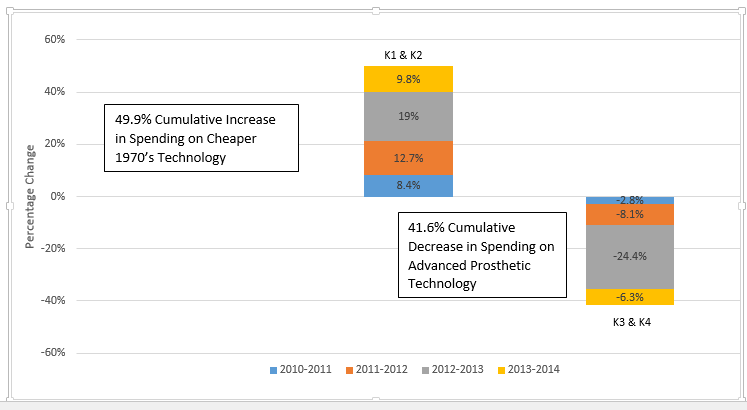
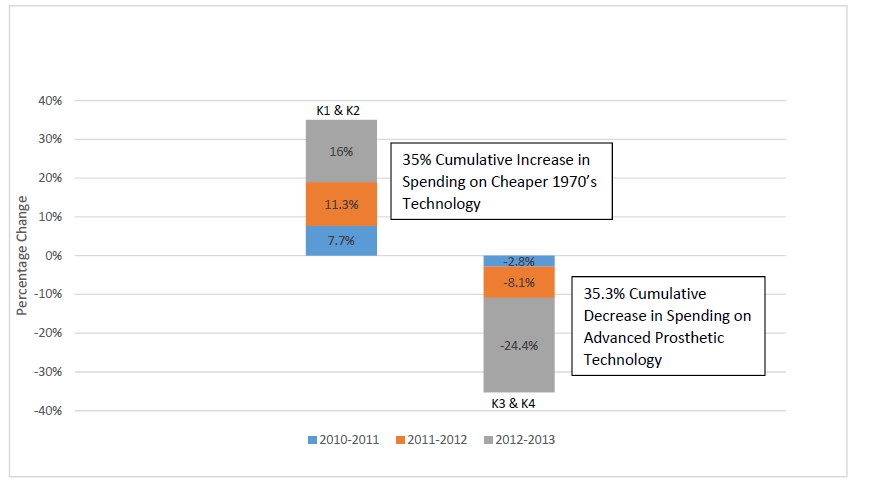
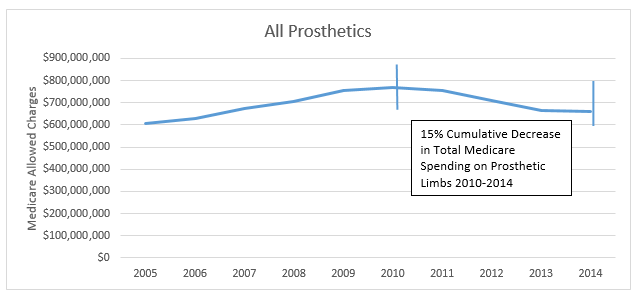
The O&P reps presented data on the reduction in Medicare spending for prosthetics in each of the past four years, 2010-14, a cumulative -15% reduction, as well as Medicare’s data showing that spending on advanced prosthetic devices for Medicare beneficiaries (K3 and K4) had dropped 41.6% over that 4 year period, while the Medicare spending on the cheaper less advanced (K1-K2) technology prosthetics had increased 49.9% over that same four-year period, clear evidence of a change in the standard of care for Medicare amputees, as well as that patients who have K3/K4 technology will now face an uphill battle in securing a comparable replacement when their current device wears out. Dr. Miller said that dollars are irrelevant to the Consensus statement, while O&P reps maintained that the evidence of a downshift in Medicare prosthetic standard of care is very germane to Best Practices. O&P reps also distributed a recent article outlining that a very substantial number of amputees never receive a prescription for a prosthetic device, and that with each advancing ten years of age, the prospect that an amputee receives such a prescription drops -50%, an especially relevant point for Best Practices since Medicare beneficiaries fall into those older patient age levels least likely to receive a prescription for a prosthesis, and thereby significantly reduced access to any prosthetic care.

Time will tell, but all reports are that it will take a year or so before we get a resolution to the question of whether (a) CMS takes the policy for lower limb prosthetics away from the DME MACs and pursues instead a National Coverage Determination; or (b) they decide after the Consensus Statement, to release the matter back to the DME MACs for them to resolve as they wish via one or more LCDs.  AOPA, in its communications with legislators, has encouraged consideration both for Congressional oversight and potential clarification to assure that the HHS statutes and rules clearly allow CMS to properly manage the activities of its contractors on LCD and all other issues, as well as supporting the concept of a moratorium to assure clarity through the end of the Obama Administration and into 2017 and beyond the inauguration of the next President.

AOPA Announces Request for Proposals for O&P Research Grants

WASHINGTON, DC – The American Orthotic & Prosthetic Association (AOPA), in partnership with the Center for O&P Learning & Evidence-Based Practice (COPL), has unveiled its 2016 Requests for Proposals (RFPs) inviting submissions for conducting Orthotic and Prosthetic research. AOPA will be funding up to four pilot grants for amounts up to $15,000 each.

“This RFP represents AOPA’s ongoing commitment to advancing data-driven initiatives in O&P. AOPA has been investing in research in an attempt to advance and develop our evidence base. We chose sixteen high priority O&P topics including an open topic to encourage promising researchers from across the profession to apply,” said James Campbell, PhD, CO, FAAOP,

President of AOPA. The 2016 research topics available for funding include Orthotic Management of Osteoarthritis; Sockets: Methods for Measuring Proper Socket Fit and Alignment; Utilization and comparative effectiveness of TLSO/LSO, among many others.

The full RFP and application can be reviewed online.

Questions? Please contact Lauren Anderson, AOPA’s Manager of Communications, Policy, and
Strategic Initiatives at 571/431-0843 or landerson@aopanet.org

What has Happened with Medicare Amputee Services Since 2010?

What has happened to Medicare’s Spending on Prosthetics since 2010?

AOPA has analyzed the data, and the picture is clear. Medicare spent 15% less in 2014 than in 2010 on prosthetics.

Medicare spending on advanced prosthetics has trended down 41%, while spending on older technologies has trended up almost 50%. Overall spending has decreased by 15% since 2010.2010-2014 medicare data

Year All Prosthetic Spending Year All Prosthetic Spending
2005 $607,797,189 2010 $770,462,739
2006 $628,220,869 2011 $756,265,554
2007 $676,421,628 2012 $710,599,456
2008 $704,604,327 2013 $664,405,441
2009 $753,410,033 2014  $662,585,471

Medicare Spending has INCREASED on antiquated prosthetics and DECREASED on Newer Technologies.

2014 medicare data technolgy

2010 2011 2012 2013 2014 Total % Change  2010-2014
K3 & K4 Feet $90,386,136 $87,863,510 $80,780,898 $61,078,042 $57,205,529 -41.6%
K1 & K2 Feet $3,123,856 $3,385,101 $3,815,199 $4,540,293 $4,98,3348 49.9%

See a breakdown of the data and more in-depth analyses.

Opportunities for Clinical O&P Research Support from the American Orthotic and Prosthetic Association

The American Orthotic & Prosthetic Association, in partnership with the Center for O&P Learning & Evidence-Based Practice (COPL), is proud to announce a Request for Pilot Grant Proposals in 16 potential areas of orthotic and prosthetic research including an open topic.

There are 16 topics total with a few examples listed below:

  • Orthotic Management of Osteoarthritis
  • Sockets: Methods for Measuring Proper Socket Fit and Alignment
  • Quality of Life, Wellness, Patient Satisfaction and/or Outcomes Studies of Patients Who Have Received O&P Care vs. Those Who Have Not
  • Open Topics – Beyond the Above Priorities, Top Quality Clinical O&P Research Topics Considered
  • See the rest of the topics in the full RFP.

AOPA and COPL will give preference to grants that address evidence-based clinical application in orthotics and prosthetics. Please post this RFP and share it with your colleagues. The deadline for proposals is April 30, 2016.

Read the full eligibility and application process.

Where is CMS Going on Prior Authorization?

AOPA has presented free webinars for members on Prior Authorization on two dates – February 18 and February 25.  AOPA is committing substantial resources to additional education related to Medicare Prior Authorization.  Details of these resources are listed below:

1.       Introductory Webinar: February 18th and 25th 2016-2 separate dates (Available as a recording)
2.       February 2016 Reimbursement Page Article: February 2016
3.       Preparation for Prior Authorization Webinar: March 24th and 31st 2016-2 Separate dates (Register)
4.       AOPA Guide to Prior Authorization (Publication- Includes Policy Review, Documentation Checklist, Resources for Physicians, PA Resubmission strategies): April 2016
5.       Educational Seminar on Prior Authorization (2-3 hour): Add on session to 2016 AOPA Policy Forum

What Happens Next and When on Prior Auth.

CMS has issued a final rule on Prior Auth and it includes O&P, so Prior Auth IS going to be part of your future!  That said, what AOPA is hearing from CMS is a relatively cautious, long-view approach.  We do NOT expect to see any list of P&O codes to be subject to Prior Auth. anytime soon-some folks looked for an O&P list to be published by the end of February—but a delay of 6 months to even 12 months seems much more likely.  Why?  Here are a few reasons: (1) CMS would like to see what happens on the pending LCD before it sets up a full mechanism for O&P Prior Auth. ; (2) CMS sees Prior Auth as something of a franchise—so far, as to power wheel chairs, it has gotten pretty good reviews, and they don’t want to risk moving too fast and getting slammed with bad results; (3) they heard the comments of AOPA, patients, Alliance and others at least as to: (a) not wanting to have Prior Auth result in patient delay in getting their prosthesis, and (b) trying to assure that the system is sufficiently well-designed that folks who receive a Prior Auth. approval are not then subject to any post-payment audits.  When a CMS O&P list does come out, an incremental approach with regional trials is more likely than any immediate national policy.

So, AOPA members have the luxury of some extra time to plan and prepare.  Obviously, while any situation with any government agency must be considered somewhat fluid as people and policies can change, AOPA’s assessment on timing is based on a solid sense of reliability of information we have received, and we are confident that it aligns with current CMS plans and timing.  Take advantage of AOPA’s Prior Auth. education programs.  Whenever Prior Auth. for O&P is implemented it will be all about having your documentation right!

And What is AOPA Advocating Regarding Prior Auth?

CMS finalized late last year a final rule establishing Medicare prior authorization requirements for durable medical equipment, prosthetics, orthotics and supplies (DMEPOS).  In the final rule, CMS included lower limb prosthetic devices as being subject to prior authorization.

  • AOPA is concerned the prior authorization process will delay timely access to prosthetic devices, which are critical to the rehabilitation needs of Medicare beneficiaries, and since the Prior Auth. rule is premised explicitly on the need to control unnecessary or excessive utilization “clearly those classes of devices showing -40+% reduction in utilization since 2010 should not be on the list of codes subject to Prior Auth.” (See the data.)
  • Moreover, AOPA is concerned that the receipt of prior authorization does not guarantee payment or the avoidance of post-payment audits. This process therefore only serves to add Medicare compliance burdens for O&P providers.

Articles Published in the Military Medicine Journal on Cost-Effectiveness of O&P Care, and OTS Orthotics

All AOPA members will be receiving in the mail a copy of the recent Military Medicine SupplementMilitary Medicine is the official journal publication of the Association of Military Surgeons of the United States (AMSUS), and this edition arises in conjunction with the topics covered at the December annual meeting of AMSUS.

There are two articles that are very important to all AOPA members which are included in the edition.  Most members are aware of the Dobson-DaVanzo study on cost-effectiveness, which demonstrates, using four years of Medicare data, that timely O&P intervention saves payers’ money (the study has been a central feature of the www.MobilitySaves.org website, and you may wish to take a look there also).  Dr. Allen Dobson, the author of this research, presented his work at the AMSUS meeting, and the attached manuscript will make this work widely available for citation for use by payers (including both Medicare and private sector providers), and others to show the value of O&P care (page 18).

Secondly, this edition also includes the manuscript developed by a Multi-Disciplinary Task Force headed by John Fisk, M.D., with physician representatives from both physical medicine and rehabilitation, and orthopedic surgery, a physical therapist, and certified O&P professionals around key issues on the orthotic treatment team, distinctions between OTS and customized orthotics, the importance of the orthotist’s notes and records, and other key clinical issues (page 11).  This publication is particularly timely in establishing this valuable consensus viewpoint at a time when orthotic care, and its reimbursement are attracting greater attention and scrutiny.

There are also several reasons why we are especially pleased to see both of these articles appearing in Military Medicine.  This journal is a peer-reviewed medical journal, listed in the Index Medicus, which conveys substantial credibility for these papers, placing it in the top tier for purposes of medical citations, and because of the importance of topics covered in this journal to Congressional Appropriations and Department of Defense matters, Military Medicine is circulated to all Congressional Offices, giving these messages great reach to our lawmakers.

Access the articles online.

Update on DME MAC Contractor Transition

Following up on a previous Smart Brief announcement, regarding upcoming changes in the contractors who will serve as the Durable Medical Equipment Medicare Administrative Contractors (DME MACs), AOPA has learned about additional details regarding the transition of DME MAC Jurisdiction A and Jurisdiction B responsibilities.

The denial of the NGS protest of the Jurisdiction B DME MAC contract award clears the way for CGS to begin transition work in preparation for its June 27, 2016 start date as the new Jurisdiction B DME MAC. CGS has announced that as of June 27, 2016, Jurisdiction B claims will be processed out of CGS existing operations center in Nashville, TN. CGS has announced that it intends to hire at least 150 staff members in Nashville to ensure that they have adequate capability to begin processing claims as of June 27th. In addition, CGS has announced that Doran Edwards, MD will serve as the Jurisdiction B DME MAC Medical Director once CGS takes over responsibility for Jurisdiction B. Dr. Edwards currently serves as an associate medical director for the Jurisdiction C DME MAC and has previously served as the medical director of the SADMERC. CGS has established a transition website where providers may learn more about the transition process. The transition website may be accessed by clicking on the following link: www.cgsmedicare.com/jb

In other news, Medicare NHIC has elected not to file a protest of the recent award of the Jurisdiction A DME MAC contract to Noridian Health Services, LLC, the current contractor responsible for Jurisdiction D and the PDAC. While this decision means that transition activities will begin shortly, Noridian has made no announcements as of yet. AOPA will continue to follow developments in both of these transitions closely.

Questions regarding this issue may be directed to Joe McTernan at jmcternan@aopanet.org or Devon Bernard at dbernard@aopanet.org

CGS to be the New DME MAC for Jurisdiction B

As AOPA reported earlier, CGS, the current Jurisdiction C DME MAC contractor, was awarded the Jurisdiction B contract on September 3, 2015. However, National Government Services (NGS), the current Jurisdiction B DME MAC, filed a formal protest causing CMS to halt the transition pending a review of the contract award by the Government Accountability office (GAO). The GAO upheld the contract award and CGS will be the new DME MAC for Jurisdiction B beginning June 27, 2016. NGS will continue to serve as the Jurisdiction B contractor until the June 27 deadline; and any questions about current claims/audits should still be directed and handled by NGS until June 24, 2016.

CGS has created a help desk; to contact the help desk dial 877-363-8895, to answer any questions suppliers may have about the transition or you may visit www.cgsmedicare.com/jb. Questions regarding this issue may be directed to Joe McTernan at jmcternan@aopanet.org or Devon Bernard at dbernard@aopanet.org