Latest Blog

HCPCS Code Changes for 2018

The Centers for Medicare and Medicaid Services (CMS) has released the new HCPCS codes for 2018, and there were only a few minor changes. Below is a complete breakdown of the code changes which will be effective for claims with a date of service on or after January 1, 2018.

 New Codes 

January 12, 2022Strategies for Effective Revenue Collection
Steady and reliant revenue collection is key to the operation of your facility. This webinar will discuss tips and strategies to ensure that your collection methods are operating effectively and efficiently; and to make sure you are collecting everything you can.
Register
February 9, 2022Lower Limb Prostheses Policy: A Review
A comprehensive review of the current Lower Limb Prostheses Local Coverage Determination and Policy Article. Learn of all the recent changes and updates to the policy, including a breakdown of the Coding Guidelines, which items require PDAC approval, and much more.
Register
March 9, 2022Medicare 101: Get to Know the Basics
The perfect webinar for the new hire, or if you want a refresher. This webinar will provide an overview of the Medicare program and how it relates to O&P care. Learn about the different parts of Medicare and how certain payment structures are created.
Register
April 13, 2022Clinicians Corner-Techs/Fitters
Join us for the first Clinician’s Corner of 2022. This installment will be focused on providing tips, tricks and insights for technicians and fitters; and is available for scientific credits.
Register
May 11, 2022Supplier Standards & Revalidations
Now that site inspections and Revalidations are back in full swing, with new contractors taking the lead, be sure you know and understand the DMEPOS Supplier Standards. Learn some tips to pass a Supplier Standards inspection and Revalidation.
Register
June 8, 2022SWOs, PODs, ABNs, AOBs: Your Must Have Documentation
Everyone focuses on the medical necessity documentation, but what about the everyday documentation you need to have in your records. This webinar will focus on the administrative documentation which is required to be on file. Learn when you must obtain a new Standard Written Order, and what it must include. Review when and who can sign an ABN, and much more.
Register
July 13, 2022Clinicians Corner- Orthotics: How To Get Started Into Digital Workflow. From Scanning, To Carving, To 3D Printing, The Next Step For O&P
Join us for the second Clinician’s Corner of 2022. This installment will be focused on providing tips, tricks and insights for orthotists and is available for scientific credits.
Register
August 10, 2022Roadmap to Appeals
This seminar will include a quick summary of the Medicare appeals process and focus on some key tips and strategies you may use to help win your appeals.
Register
September 14, 2022An Operations Presentation
Learn how your daily operational practices can impact your business. Review and learn about ways to improve your operations, possible discussion topics could include how to identify and avoid common denial reasons, best practices for patient intakes and more.
Register
October 12, 2022Clinicians Corner-Prosthetics
Join us for the final Clinician’s Corner of 2022. This installment will be focused on providing tips, tricks and insights for prosthetists and is available for scientific credits.
Register
November 9, 2022The Do’s & Don’ts of Gift Giving
As the holiday season approaches you may want to provide gifts to your patients and/or your referral sources. This webinar will review the rules around providing gifts and inform you of the steps you should take to remain compliant.
Register
December 14, 2022Year End Review & What is Ahead
As the year comes to end be sure you have not missed anything important. This webinar will highlight all the updates and changes in policy, reimbursement and coding which occurred in 2022; and will provide insight to any changes or updates coming in 2023.
Register

Changes in Code Descriptors 

Company NameBooth #Website
ACOR Orthopaedic Inc.
745www.acor.com
Adapttech1049www.adapttech.eu
Allard USA Inc.
535www.allardusa.com
Alps South LLC819www.easyliner.com
ALPS is a leading manufacturer of prosthetic liners and prosthetic accessories. It is our mission to assist in “Making Lives Better”, it is this mission that pushes us to provide superior products and service for all customers. Dedicated to innovation, we strive to come up with new products to fit your every need. This year we have launched our new Vacuum Integrated Pump (VIP), Smart Seal and Silicone Pro Liner.
Alternative Prosthetic Services Inc.750www.alternativeprosthetics.com
American Academy of Orthotists & Prosthetists650www.oandp.org
American Board for Certification in Orthotics, Prosthetics & Pedorthics
949www.abcop.org
American Central Fabrication
1146
American Congress of Rehabilitation Medicine (ACRM)1540www.acrm.org
American Prosthetic Components, LLC
1334www.apcomponents.com
AMFIT INC.
641www.amfit.com
Amputee Coalition
1423www.amputee-coalition.org
Anjon Holdings1531www.anjonholdings.com
Anodyne
741www.anodyneshoes.com
AON1342
Apis Footwear Co.
1338www.apisfootwear.com

Artec 3D1214www.artec3d.com
Aspen Medical Products
1417www.aspenmp.com
Becker Orthopedic Appliance Co.
529www.beckerorthopedic.com
BioSculptor Corp.
1340www.biosculptor.com
Bioskin1526pro.bioskin.com
Biostep Inc.1541www.biosteportho.com
Blatchford Inc. 717www.blatchfordus.com
Bluewave Technologies
322www.mybluewave.com
Board of Certification/Accreditation (BOC)
1446
www.bocusa.org
Boston Orthotics & Prosthetics
1126www.bostonoandp.com
Bort-Swiss Orthopedic Supply
844www.bort-swissortho.com
Brightree LLC
1243www.brightree.com
BroadBay, LLC
1149www.broad-bay.com
Bulldog Tools Inc.
421www.bulldogtools.com
California Orthotics and Prosthetics Association (COPA) 1245www.californiaoandp.com
Cal State University Dominguez Hills O&P Program1529www.csudh.edu/oandp
Cascade Dafo Inc.
1143www.cascadedafo.com
Cascade Orthopedic Supply Inc.
835
www.cascade-usa.com
CBS Medical Billing & Consulting LLC

751
www.cbsmedicalbilling.com
Challenged Athletes Foundation1524www.challengedathletes.org
Click Medical
951
clickmedical.co
Coapt LLC
520www.coaptengineering.com
College Park Industries
1317
www.college-park.com
Comfort Products Inc.
1134
www.comfortoandp.com
Coyote Prosthetics & Orthotics
1239
www.coyoteprosthetics.com
Create O&P
1448
www.createoandp.com
Curbell Plastics, Inc.
1444
www.curbellplastics.com/oandp
Cypress Adaptive, LLC

1247

www.cypressadaptive.com
DAW Industries Inc.
429www.daw-usa.com
DJO
1520
www.djoglobal.com
DME MAC MEDICARE
1031
www.cgsmedicare.com
DOD-VA Extremity Trauma and Amputation Center of Excellence (EACE)1314https://health.mil/about-MHS/OASDHA/HSPO/EACE

Drew Shoe Corp
1441www.drewshoe.com
Endolite
717www.endolite.com
Engineered Silicone Products LLC
1140www.wearesp.com
Epica Applied Technologies
1339www.epicatech.com
Fabtech Systems LLC
1516www.fabtechsystems.com
Fillauer
617www.fillauer.com
FIOR & GENTZ GmbH
538www.fior-gentz.us
FIT3601530www.ff360-sw.com
FLO-TECH® Orthotic & Prosthetic Systems Inc.
435www.1800flo-tech.com
Forrest Stump1414www.forreststump.org
Freedom Innovations LLC
925www.freedom-innovations.com
Friddle's Orthopedic Appliances Inc.
1242www.friddles.com
Grace Prosthetic Fabrication Inc.
425www.gpfinc.com
Hi-Tech1539www.humanitechnology.com
Hope to Walk1513www.hopetowalk.org
HP1344www8.hp.com/us/en/printers/3d-printers.html
Infinite Biomedical Technologies
1528
www.i-biomed.com
Integrum Inc.
534www.integrum.se
International Institute of Orthotics and Prosthetics
1035www.iiofoandp.org
Invent Medical USA LLC
1025
www.inventmedical.com
Kevin Orthopedic748www.kevinorthopedic.com
Kinetic Research Inc.
549www.KineticResearch.com
KISS Technologies LLC
840www.kiss-suspension.com
KLM Laboratories
1213klmlabs.com
Knit-Rite Inc.
735www.knitrite.com
LaunchPad O&P
1014
www.launchpad-op.com
LegWorks945www.LegWorks.com
LIM Innovations
1113www.liminnovations.com
Limb Loss and Prevention Registry342www.mayo.edu/research/labs/motion-analysis/research/limb-loss-preservation-registry
LIMBTEX LTD.320www.limbtex.com
Martin Bionics Innovations
1443www.martinbionics.com
MD Orthopaedics Inc.
439www.mdorthopaedics.com
Medex International Inc.
1048medexinternational.com
Medi Lazer
326www.Rxloupes.com
Mile High Orthotics Lab Inc.
545www.mholabs.com
Monetek LLC
1345www.monetek.com
Motion Unlimited
1537www.motion-unlimited.com
Myomo
541www.myomo.com
Naked Prosthetics
1045www.npdevices.com
National Commission on O&P Education
648www.ncope.org
Neuros Medical, Inc.328www.neurosmedical.com

New Step Orthotic Lab Inc.
1241www.newsteporthotics.com
nora systems Inc.
651www.nora-shoe.com
Northwestern University Prosthetics Orthotics Ctr.
354
Nymbl Systems
1235www.Nymbl.Healthcare
O&P EDGE/Western Media LLC
846www.opedge.com
O&P State Meetings338www.cecpo.com/services/meeting-planning
OHI
1355ohi.net
OPAF & The First Clinics
1525
www.opfund.org
Open Bionics
1535www.openbionics.com
OPIE Software
727www.opiesoftware.com
OP Solutions Inc
1047OPSolutions.us
OPTEC USA, INC
www.optecusa.com
Orfit Industries America
1041www.orfit.com
Orthofeet
1543
www.orthofeet.com
Orthomerica Products Inc.
523www.orthomerica.com
Orthotic & Prosthetic Group of America (OPGA)
1135www.opga.com
Osseointegration Group of Australia350
Osseointegration.org
Össur Americas Inc.
935www.ossur.com
Ottobock
1117
www.ottobockus.com
Paceline
1429www.paceline.com
Pedorthic Foundation
324
www.pedorthicfoundation.org
Pedorthic Services
1015www.pedserv.com
PEL
1229www.pelsupply.com
PLS - Pedorthic Lab Specialties1413www.pedorthiclab.com
Powerstep1132www.powerstep.com
Proclaim Billing Services 1144www.cornerstonepo.com
ProsFit Technologies1344www.prosfit.com
Proteor USA
1327www.proteorusa.com
PSYONIC
1347www.psyonic.co
Range of Motion Project (ROMP)1522www.rompglobal.org
Renia GmbH
649www.renia.com
Restorative Care of America Inc.
1029www.rcai.com
Rodin 4D848 & 849
www.rodin4d.com
Royal Knit Inc.847www.royalknit.com
RS Print644rsprint.com
Silipos842www.silipos.com

Sole Mates815
Soletech Inc.
1147
www.soletech.com
Spinal Technology, Inc.
841www.spinaltech.com
SPS
919www.spsco.com
Springer Aktiv AG1114
www.springer-berlin.de
ST&G USA Corp.
645www.stngco.com
SteeperUSA
1349www.steeperusa.com
SureStep
627www.surestep.net
Tamarack Habilitation Technologies Inc.
524www.tamarackhti.com
TechMed 3D Inc.
747www.techmed3d.com
Thermo-Ply, Inc.
1425www.thermoplygel.com
Tillges Technologies LLC
640www.tillgestechnologies.com
Top Shelf Orthopedics
1348www.topshelforthopedics.com
Townsend Design (Thuasne USA)
1129www.thuasneusa.com
Trend Medical1130www.trend-med.com
TSM Smart Materials Co., Ltd.1246www.tsm-smart.com
Turbomed Orthotics Inc.
946turbomedorthotics.com
Ultraflex Systems, Inc.
1450www.ultraflexsystems.com
University of Hartford MSPO Program
356www.hartford.edu/tmspo

US ISPO336www.usispo.org
VA Office of Research & Development1519
VitalFitsr
914
www.VitalFitsr.com
Vorum
635www.vorum.com
VQ Orthocare
1517
www.vqorthocare.com
WillowWood
517
www.willowwoodco.com

As a reminder registration is still open for the December 13, 2017 AOPAversity webinar, New Codes & Other Updates for 2018, which will focus on the changes to the HCPCS code set and any other upcoming Medicare changes which may impact your business in 2018. AOPA’s Coding and Reimbursement Committee will review the list of changes and provide appropriate comments to CMS.

Questions regarding the code changes may be directed to Joe McTernan at jmcternan@aopanet.org, or Devon Bernard at dbernard@aopanet.org.

CMS Responds to AOPA Concerns Regarding Custom Fabricated Diabetic Inserts

AOPA is pleased to announce that the Centers for Medicare and Medicaid Services (CMS) has proposed a change to the DMEPOS Quality Standards that addresses AOPA’s concern regarding the recent DME MAC/PDAC interpretation of the term “molded to patient model” when used to describe custom fabricated diabetic shoe inserts.  The proposed change to the quality standards allows for the creation of a digital positive model of the patient’s foot using CAD/CAM technology that is then used to direct mill a custom fabricated insert based on the digital model.

In July, 2017, the DME MACs and PDAC issued a joint bulletin that stated that in order to meet the definition of “molded to patient model” contained in the descriptor for A5513, diabetic inserts must be fabricated over a physical model of the patient’s foot.  The bulletin went on to state that digital or virtual models that were used to direct mill custom inserts are not considered a positive model and inserts fabricated using this technique do not meet the code requirements of A5513 and therefore must be billed as A9270, a statutorily non-covered HCPCS code.  On September 28, 2017, AOPA and the American Podiatric Medical Association (APMA) submitted a joint letter to CMS expressing their concern over this bulletin as it represented a significant threat to the use of advanced technology to provide better clinical service.  In addition to working directly with the APMA, AOPA worked closely with the O&P Alliance, Representative Wenstrup’s (R-OH) office, his staff, and the House VA Subcommittee on Health to make sure that this issue remained at the forefront of the discussion.

On November 2, 2017, CMS announced a proposed change to the DMEPOS Quality standards that would include the use of digital or virtual models to direct mill custom diabetic inserts as an acceptable method to meet the definition of “molded to patient model” contained in the code language for A5513.  CMS will hold an Open Door Forum call on November 28, 2017 at 2:00 pm EST to allow experts to discuss the proposed changes to the DMEPOS Quality Standards and will accept comments on the proposed changes through December 11, 2017.  Comments on the proposed changes may be sent to CMS via e-mail at ReducingProviderBurden@cms.hhs.gov.  CMS has indicated that it intends to finalize the proposed changes by January 1, 2018.

AOPA will participate in the Open Door Forum call and will be preparing comments for submission to CMS.

Review the proposed changes.

Take Action Now to Stop the Department of Veterans Affairs from Limiting Your Veteran Patients’ Right to Choose

The October 16, 2017 Federal Register included a proposed rule published by the Department of Veterans Affairs (VA) that intends to “reorganize and update the current regulations related to prosthetic and rehabilitative items, primarily to clarify eligibility for prosthetic and other rehabilitative items and services, and to define the types of items and services available to eligible veterans.”

There is a provision in the proposed rule that significantly threatens longstanding VA policy that allows the veteran to decide whether they receive O&P services directly from the VA or from a VA contracted provider.  This provision requires an immediate and powerful response.  The proposed language states the following:

“VA will determine whether VA or a VA-authorized vendor will furnish authorized items and services under § 17.3230 to eligible veterans. When VA has the capacity or inventory, VA directly provides items and services to veterans. However, VA also may use, on a case-by case basis, VA authorized vendors to provide greater access, lower cost, and/or a wider range of items and services. We would clarify in regulation that this administrative business decision is made solely by VA to eliminate any possible confusion as to whether a veteran has a right to request items or services generally, or to request specific items or services from a provider other than VA, and to clarify for the benefit of VA-authorized vendors that VA retains this discretion as part of our duty to administer this program in a legally sufficient, fiscally responsible manner.”

This language, if finalized, is in direct conflict with the current VA policy as well as the Veteran’s Access, Choice, and Accountability Act of 2014 and will significantly restrict the ability of a veteran to see the VA contracted provider of their choice for prosthetic and orthotic care.

AOPA has established a convenient pathway that will allow you to quickly express your concern regarding the VA proposed rule.  Simply visit www.AOPAVotes.org, enter some basic information, and a customized letter will be generated and sent to the VA to express your concern over the unnecessary and unreasonable provisions of the proposed rule. Send comments now.

Agency for Healthcare Research and Quality Releases its Draft Systematic Review of Lower Limb Prostheses Research

The Agency for Healthcare Quality Research (AHRQ), in conjunction with a contractor known as an Evidence-based Practice Center, has released a draft systematic review of current scientific literature that address the use of lower limb prostheses in the United States.  The Systematic review was originally announced in September of 2016 with a request for additional comments in December of 2016 on the “key questions” that would be used in the systematic review.  AOPA provided significant comments on the systematic review itself as well as on the key questions issue.

While the complete systematic review document is 440 pages and is currently under review by AOPA, the abstract of the systematic review indicates the following:

  • 92 studies were identified that assessed performance characteristics of lower limb prostheses
  • 29 of the 92 studies were deemed valid and reliable by the researchers
  • 19 of the 29 studies were generally applicable to Medicare aged populations
  • 11-22% of amputees abandon their lower limb prosthesis within one year of delivery
  • Unilateral trans-femoral amputees are twice as likely to abandon their prosthesis than unilateral trans-tibial amputees
  • Currently, there is not evidence to support the selection of specific components for patient subgroups to maximize ambulation, function, and quality of life or to minimize abandonment or limited use
While AOPA supports the need to review the current research that addresses lower limb prostheses, we do not agree with much in the conclusions, and particularly its final abstract conclusion noted above, as there is clear evidence, apparently not considered by AHRQ or its contractor to support specific components for patient subgroups for maximizing favorable patient outcomes.  It is important to recognize that the draft systematic review did not include recent research by the RAND Corporation and the health economics firm Dobson DaVanzo that specifically studied both the clinical and cost effectiveness of the provision of higher technology prosthetic limbs, despite AOPA’s having submitted BOTH preliminary findings of both studies before the December, 2016 AHRQ deadline, as well as the final study results of both being submitted to AHRQ as soon as the first became available seven (7) weeks ago.  It is particularly unfortunate to see a purportedly current literature review be deficient in not reflecting the latest determinative scientific findings.

AOPA will be preparing extensive comments on the draft systematic review and encourages its members to review the document and provide comments as appropriate.

AOPA Holds Press Event on the “Amputee Tech Gap” 

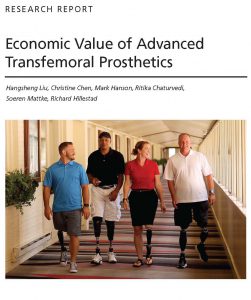
On October 19, AOPA hosted a press event at the National Press Club in Washington DC, to share the important research from the RAND Corporation on the economic value of advanced prosthetics.

Dr. Soren Mattke from RAND presented the findings of this recently published research that concluded that microprocessor knees are associated with improvements in physical function and reductions in falls and osteoarthritis, and that the economic benefits are in line with commonly accepted criteria for good value for money by U.S. payers.

Dr. Ken Kaufman, PhD of the Mayo Clinic, shared his research on health outcomes for those living with limb loss, including the cost of care broken down by K-level, and the costs of falls, and the large number of amputees who never receive a prescription for a prosthesis. Prosthetic users Christopher Allen and Peggy Chenoweth discussed how they have benefited from advanced technology in their everyday lives.

The video was livestreamed on Facebook and is now available to view. The Power Point presentations used are available upon request.

About the RAND Corporation study 
Due to recent advances in technologies, prosthetic knees allow for more-dynamic movements and improve user quality of life, but payers question their value for money. To explore this issue, RAND simulated the differential clinical outcomes and costs of microprocessor-controlled knees (MPKs) compared with non-MPKs (NMPKs). They conducted a literature review of the clinical and economic impacts of prosthetic knees, convened technical expert panel meetings, and implemented a simulation model over a ten-year time period for unilateral transfemoral Medicare amputees with Medicare Functional Classification Levels of 3 and 4.

They found that compared with NMPKs, MPKs are associated with sizeable improvements in physical function and reductions in incidences of falls and osteoarthritis. The simulation results show that over a ten-year time period, compared with NMPKs, MPKs are associated with an incremental cost of $10,604 per person and an increase of 0.91 quality-adjusted life years per person, resulting in an incremental cost of $11,606 per quality-adjusted life year gained. The results suggest that the economic benefits of MPKs are in line with commonly accepted criteria for good value for money and with those of other medical devices that are currently covered by U.S. payers.

Read the RAND Study.

This study is just part of AOPA’s commitment to advancing O&P research. See all of AOPA’s Research Initiatives.

Press about the Event so far:


O&P Edge– RAND Study: Far Fewer Falls With MPKS
Medscape– Modern Prosthetic Knees Cut Falls, Morbidity, Mortality in Amputees (login required)
Rehab Management – Amputees Are Being Denied Access to Higher-Tech Prostheses, Resulting in Preventable Injury and Death, Per RAND Study
NJTV PBS – Prosthetics tech gap costs money and lives according to report
Healthcare Business Daily News- Payors less inclined to cover high-tech prosthetics for amputees

RAND Corporation Study: “Tech Gap” Puts U.S. Amputees At Greater Risk Of Injury, Death As Medicare, Private Payers Deny Access To Newer Artificial Limbs

Denial of Access to New Microprocessor-Controlled Knees Seen As Resulting in Preventable Falls, Deaths; Forcing Amputees to Use Riskier 1970s Technology Seen As Saving Little Money Over Lifetime.

WASHINGTON, D.C. – U.S. amputees are facing a “tech gap” in which Medicare and private health insurers deny access to new microprocessor-controlled knees (MPKs) that are only slightly more expensive over a lifetime and considerably safer in terms of preventable injuries and deaths than the alternative “1970s-style” artificial lower limbs. Those are among the key findings of a major new report issued today by the RAND Corporation and available online from the American Orthotics & Prosthetics Association (AOPA) at: https://bit.ly/randstudy.

Every week in the U.S., more than 3,500 people undergo a transfemoral amputation. Of the 185,000 new amputee patients each year, an estimated 25-30 percent receive a prosthetic leg and knee.

However, fewer and fewer U.S. amputees are getting access to the new, safer technology and, instead, find themselves confined to the older and more dangerous 1970s-style tech. The RAND Corporation study notes that Medicare total payments for prosthetics declined 15 percent during the 2010-14 period despite advances in technologies. (Private insurers have historically taken their cues from Medicare as to possible cuts in coverage.)

The RAND Corporation study shows that 26 percent of patients who received more advanced prosthetic limbs with MPK will fall per year as opposed to 82 percent of patients with the older non-MPK limbs. There are 14 fall-related deaths per 10,000 patient years for non-MPK amputees, and three fall-related deaths per 10,000 patient years for the MPK amputees, which means up to 11 lives per 10,000 patient years could be saved through wider MPK usage. The data show only 38 falls per 10,000 patient years resulting in injuries suffered by users of the higher-tech MPK versus 182 falls per 10,000 patient years for non-MPK amputees.

Dr. Soeren Mattke, managing partner, Health Care Practice, RAND Corporation, Boston, MA, said: “Due to recent advances in technologies, prosthetic knees and feet allow for more dynamic movements and improve user quality of life, but payers have recently started questioning their value for money … the microprocessor controlled knee is associated with sizeable improvement in physical function and reductions in incidences of falls and osteoarthritis …The results suggest that the incremental cost of MPK is in line with commonly accepted criteria for good value for money and with the incremental cost of other medical devices that are currently covered by U.S. payers.

Kenton Kaufman, PhD, Department of Biomedical Engineering, Mayo Clinic, Rochester, MN., said: “Even if an amputee with the older technology avoids death due to a fall, he or she may suffer very serious consequences from a fall-related injury. The average additional cost in the six months following a fall can be substantial. The cost for individuals requiring an emergency department visit is about $18,000. For patients who had to be hospitalized, this extra expense is over $25,000. We know our cost estimate underestimates the true cost of a fall, because we didn’t include indirect costs, such as lost wages, caregiving expenses and transportation costs.

Dr. Kaufman was summarizing the findings of a new Mayo Clinic research published in July 2017. See: https://newsnetwork.mayoclinic.org/discussion/prosthetic-knee-type-may-determine-cost-of-care-foramputees/?utm_source=facebook&utm_medium=sm&utm_content=post&utm_campaign=mayoclinic&geo=national&placementsite=enterprise&mc_id=us&cauid=100502&linkId=39637813.

Michael Oros, CPO and president, American Orthotic & Prosthetic Association, and CEO, Scheck & Siress, Chicago, Illinois, said: “This is not a case of amputees wanting to have access to new technology just because it is new. To the contrary, new tech versus old tech can be a life-anddeath issue for an amputee. The RAND Corporation study we are helping to release today shows that there is a much higher risk of injury or death when Medicare and private payers refuse to permit access to the only slightly more expensive new generation of artificial knee and lower limb. And there is a huge quality of life issue here. Amputees who are stuck with the 1970s style tech tend to be less mobile in addition to being more vulnerable to risk of injury or death.

In the summer of 2015, AOPA led a national campaign to oppose a Medicare rule that would have placed even more restrictions on both access to these very MPK devices and more sharply reduced the quality of current-technology care provided to amputees in the federal program. In that case, the Association opposed a draft proposal that remains in doubt. See: AOPA AC News Conference on LCD Policy.

VA Proposed Rule Includes Troubling Provision Restricting Veterans’ Ability to Receive Care from Their Chosen Provider

The October 16, 2017 Federal Register included a proposed rule published by the Department of Veterans Affairs (VA) that intends to “reorganize and update the current regulations related to prosthetic and rehabilitative items, primarily to clarify eligibility for prosthetic and other rehabilitative items and services, and to define the types of items and services available to eligible veterans.  While the 48 page proposed rule will require some time to be reviewed completely, there is a provision in the proposed rule that is of immediate concern to AOPA.

Page 29 of the proposed rule includes a provision regarding how prosthetic, orthotic, and other rehabilitative services will be delivered to veterans.  The proposed language states the following:

“VA will determine whether VA or a VA-authorized vendor will furnish authorized items and services under § 17.3230 to eligible veterans. When VA has the capacity or inventory, VA directly provides items and services to veterans. However, VA also may use, on a case-by case basis, VA authorized vendors to provide greater access, lower cost, and/or a wider range of items and services. We would clarify in regulation that this administrative business decision is made solely by VA to eliminate any possible confusion as to whether a veteran has a right to request items or services generally, or to request specific items or services from a provider other than VA, and to clarify for the benefit of VA-authorized vendors that VA retains this discretion as part of our duty to administer this program in a legally sufficient, fiscally responsible manner.”

This language, if finalized, will significantly restrict the ability of a veteran to see the VA contracted provider of their choice for prosthetic and orthotic care and must be addressed immediately.  AOPA, its Board of Directors, and its VA Committee are reviewing this proposed change in VA policy, which appears to be almost completely contrary to longstanding VA policy regarding veteran provider choice and the intent of the Veteran’s Access, Choice, and Accountability Act of 2014 which empowered Veterans to take a more active role in assuring their ability to receive convenient and timely care, whether through the VA directly or through the private sector.

Anticipating an AOPA position in opposition to this proposal, look for instructions as to how AOPA members can engage and mobilize patients on this important new proposed direction for prosthetic and orthotic care for Veterans.

The full text of the proposed rule may be viewed by clicking VA Proposed Rule

###

Short-Term Health Insurance, End of Subsidies Paid to Health Insurers—What Does It Mean to You and Your Patients?

On October 12, President Trump undertook a non-legislative overhaul of the country’s healthcare insurance program, and some significant administrative ‘repeal’ of the Affordable Care Act. Two major executive actions comprise this effort:

(1) clearing the path for sale of “short-term” insurance plans that do not have full ACA essential health benefits and other rules, at lower rates for healthy individuals, as well as clearing the path for sale of insurance through ‘association plans’ that will include sale of insurance across rate lines without meeting state license laws (parity laws from one state may not apply to plans sold by an out-of-state carrier who operates in a state that does not have parity rules). At peak, there were only about 100,000 Americans enrolled in these short-term plans, so immediate effect will probably not be dramatic. That said, this does initiate a segmenting of the market, incentivizing some healthy persons not to participate in the state-level insurance exchanges under ACA, but to gravitate to these cheaper, less robust short-term plans. If this snowballed to having much larger number of people in short-term plans it would tend to shift the risk pool in the exchanges in the direction of the unhealthier Americans, likely de facto giving them some characteristics of higher risk pools. Indirectly, persons with pre-existing conditions could find themselves relegated to the exchanges and their insurance rates would probably increase across the board without the balance of exchange participation by healthier individuals.

(2) The administration will stop providing the $7 billion in annual, so-called CSR subsidies to health insurers to help cover the co-pays and deductibles of lower income individuals. This is facilitated because of legal challenges where one federal district court deemed these subsidies illegal. Ending the subsidies creates some hard decisions for insurers. They may: (1) continue the credits for co-pays/deductibles without collecting any off-setting subsidy payments which would result in little change in policyholder experience in the short run (some insurers already issued major hikes in 2018 rates, likely anticipating that the subsidy payments would end); (2) thirty-two states will allow insurers to levy a surcharge to offset the loss of subsidies and thereby increasing the premiums (low cost insureds will be eligible for larger tax credits essentially offsetting these larger premiums so they won’t have too much pressing them to drop coverage), or (3) with subsidies unavailable, insurers are permitted to withdraw from the 2018 ACA insurance exchanges in each state over the next few weeks before annual enrollment in the ACA plans begins.

There is a timing disconnect. It will take a substantial amount of time for folks at HHS and CMS to write and implement the many new rules that will be needed to effectuate the short-term plans and association plans. So, these short-term plans will probably not be available for months or perhaps up to a year, even as the subsidy situation could push many folks from their current plans. Providers will want to take more special care that patients are enrolled and paid in their plans before delivering care. It’s important to recognize that, at least in the near term, these changes will impact only a portion of the health insurance market. In the short term; employer-based plans, Medicare, Medicaid, and VA, will remain unaffected—though in the longer term the premiums for these plans may change.

There are likely to be lawsuits challenging both of these steps. Both hospitals and health insurers will oppose these steps—hospitals because it will shift many more uninsured folks into emergency rooms, and increase uncompensated care (the expense of which falls on the hospitals), and insurers because, obviously, they want the subsidies. Look for attempts at legislation to stabilize insurance premiums.

Clearly, a time of change has been initiated that will impact providers over coming months. Depending on how health insurers respond, the results could have our health care looking more like it did before the ACA was enacted: more lower income people uninsured; sicker people potentially paying higher premiums, no assured universal essential health benefits, more people seeking care in hospital emergency rooms listed as uncompensated care, but actually with the cost of their coverage subsidized by higher costs for paying patients and cost-shifting. Can the President do this on his own? We will need to wait through a few years and watch the results on a likely bevy of litigation that will begin to unfold. One enduring fact will be that so long as the Affordable Care Act remains the law, any executive actions taken and regulations enacted by one President will be subject to the prospect of complete reversal by another President.

Stay tuned for what may be a somewhat turbulent ride. We’ll continue to keep AOPA members informed of significant developments.
##
October 13, 2017

AOPA and APMA Send Letter to CMS Administrator Regarding A5513 Coding

On Friday, September 29, 2017 AOPA and the American Podiatric Medical Association (APMA) sent a joint letter to CMS Administrator Seema Verma expressing their concern about the recent DME MAC coding clarification for HCPCS code A5513.

The coding clarification essentially states that in order to bill Medicare for a custom fabricated diabetic insert using HCPCS code A5513, a physical model of the patient’s foot must be created and that the insert must then be molded over the physical model of the foot.  The clarification further states that processes that use a “virtual” model to create a custom fabricated diabetic insert through direct milling or another manufacturing process do not meet the code language for A5513 and therefore must be billed using A9270 which is a HCPCS code used to describe statutorily non-covered services.

The AOPA/APMA letter expresses the concern that the overly strict interpretation of the descriptor language for A5513 limits the use of advanced technologies such as direct milling and 3-D printing to produce diabetic inserts that may result in a more intimate fit for the patient, possibly leading to better outcomes.  The letter also states that the relatively small annual Medicare expenditure for custom diabetic inserts when compared to the overall Medicare expenditure for the treatment of diabetes mellitus is so minimal, that it seems unlikely that “splitting hairs” over such a minor issue will result in any real savings to the Medicare program but will have a negative impact on patient outcomes.

The joint letter suggests that CMS can solve the issue by either instructing the DME MACs and PDAC to be less restrictive in their interpretation of the code language for A5513 or by asking the CMS HCPCS panel to consider a verbiage change that would allow providers to bill custom diabetic inserts as A5513 without the requirement that the inserts be molded to a physical model of the patient’s foot.

Read the AOPA/APMA joint letter.

CMS Withdraws BIPA 427 Proposed Rule

On October 3, 2017, the Centers for Medicare and Medicaid Services announced that it has withdrawn the proposed rule that represented the first step in creating regulations that would implement the qualified provider provisions for prostheses and custom fabricated orthoses legislated in section 427 of the Benefits Improvement and Protection Act of 2000 (BIPA).  The notice of withdrawal will be officially published in the October 4, 2017 Federal Register.

According to the notice published by CMS the proposed rule is being withdrawn due to “the cost and time burdens that the proposed rule would create for many providers and suppliers, particularly the cost and burden for those providers and suppliers that are small businesses, and the complexity of the issues raised in the detailed public comments.”  CMS indicated that they received over 5,000 public comments regarding the proposed rule.

AOPA is disappointed that CMS decided to withdraw the proposed rule that would finally create regulations to implement a law that was passed more than 17 years ago.  The withdrawal of the proposed rule once again exposes the Medicare population to no regulation regarding what qualifications are required to provide custom orthotic and prosthetic services.  While the proposed rule was far from perfect, as AOPA expressed in its public comments that were submitted to CMS, AOPA believed that issues that were of significant concern to several provider groups, who viewed the proposed rule as a threat to their ability to continue to provide services within their scope of practice, could have been addressed through changes to the final rule rather than through the complete withdrawal of the proposed rule.

The combination of the recent administration change, including the new administration’s philosophy to reduce overall regulatory burden on businesses, the significant opposition from several high profile provider groups, and the restrictive language that would significantly limit certain providers from continuing to provided custom orthoses and prostheses appear to have led directly to the demise and subsequent withdrawal of the proposed rule.

AOPA will continue to make every effort to ensure that all recipients of O&P care receive that care from folks who have been properly educated and trained in the fabrication, fit, and delivery of orthotic and prosthetic devices.

View the CMS notice.