
Bretta Fylstra, PhD: Putting the ‘Evidence’ in Evidence-Based Care
Research scientist aims to improve patient care through the analysis and development of clinical outcomes
FRESH FACES
The Fresh Faces column introduces readers to prominent O&P professionals who are making an impact with their contributions to the orthotics and prosthetics profession. This month, we speak with Bretta Fylstra, PhD.
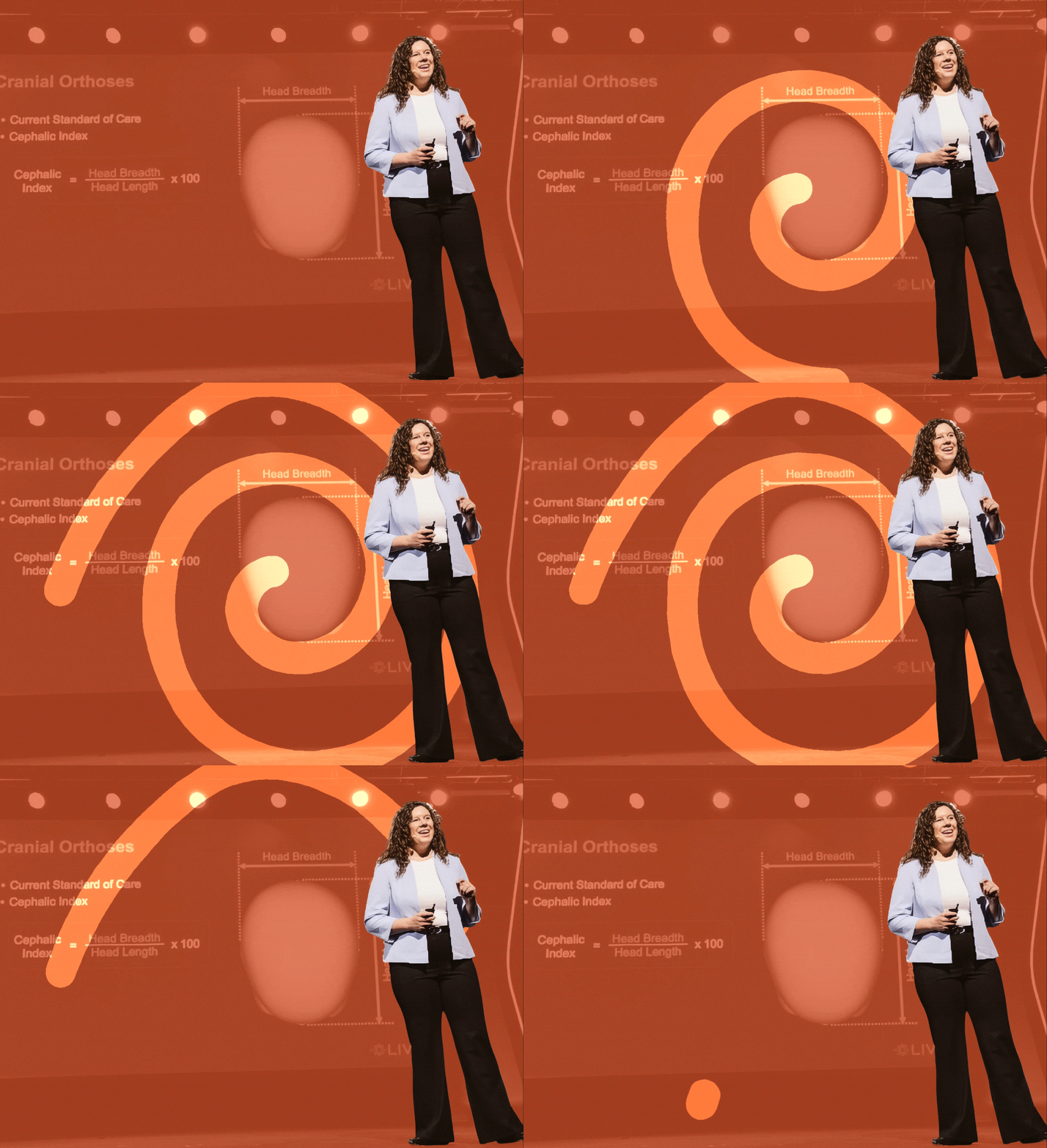
Pictured above: Fylstra presented during the Hanger LIVE Clinical Keynote sessions in both in 2024
Bretta Fylstra, PhD, is a research scientist in the Hanger Institute for Clinical Research and Education who believes that changing the future of O&P care starts with a solid foundation of evidence. Fylstra is currently involved with coordinating clinical studies, analyzing patient data, publishing manuscripts, presenting at conferences, and writing grants with the Hanger Institute’s academic and industry partners.
O&P Almanac: What motivated you to pursue a career in O&P?
Bretta Fylstra, PhD: In eighth grade, I distinctly remember an assignment where we had to take a personality test and explore career paths that would be a good match. My results indicated that I would be best suited for teaching—but I wasn’t convinced, so I started looking at careers more focused on math and science.
I came across biomedical engineering, and the picture next to that career path was of a prosthetic hand. It felt like the perfect career, combining my love of math, science, making things, and helping people.
Funny enough, teaching has become part of what I do, so it feels like I have come full circle, getting to pursue my passions on a daily basis.
O&P Almanac: Where did you pursue your education, and how did that shape your career path?
Fylstra: I completed my bachelor’s degree at the University of Delaware in biomedical engineering and my doctorate in the joint Department of Biomedical Engineering at North Carolina State University (NCSU) and University of North Carolina (UNC)—Chapel Hill.
In my time at Delaware, I was able to start my research career beginning in my freshman year, complete an internship with Independence Prosthetics and Orthotics to shadow both clinicians and technicians, learn all about motion capture and human gait, create the Orthotics and Prosthetics Club to host guest speakers, work on design projects, and learn about the various careers available in O&P. I even did my senior design project with Independence to continue working with O&P clinicians and technicians for an entire semester.
In my time at NCSU and UNC-Chapel Hill, I was able to continue my biomechanics-related work and explore how users react to a powered prosthesis and in turn, how a powered prosthesis reacts to a user.
These experiences helped to shape my path toward O&P research that takes information that we learn in the lab and understanding how that knowledge impacts individual people in the real world.
O&P Almanac: How did your undergraduate and graduate work result in multiple peer-reviewed publications and presentations?
Fylstra: As an undergraduate student, I had the opportunity to work on my own project as my honors thesis and use some of the data I was collecting as part of a published manuscript with my faculty mentor, Elisa Arch, PhD.
In grad school, I worked on my own research studies, which resulted in two manuscripts, and also assisted my fellow graduate students with their projects—resulting in additional manuscripts all under my faculty mentor, Helen Huang, PhD. I also had the opportunity to present nationally and internationally at several conferences: the American Society of Biomechanics; Dynamic Walking; Biomedical Engineering Society; and Engineering in Medicine and Biology Society conferences.
O&P Almanac: What led to your decision to become an O&P researcher?
Fylstra: With my engineering background and almost eight years of O&P research experience at the end of my graduate education, I had developed a love and passion for the O&P field. I met so many great people from my time shadowing in O&P clinics and inviting users into our lab for testing and feedback of new O&P technologies, and it really opened my eyes to how much work still needs to be done to improve outcomes and quality of life for people with limb loss and limb difference.
That realization motivated me to pursue a position that would enable me to stay involved with the O&P field and transition to a more clinically translatable role focused on improving patient outcomes.
O&P Almanac: Can you share some information about your current position at Hanger Clinic?
Fylstra: I joined the Hanger Institute for Clinical Research and Education as a postdoctoral researcher in 2022 and now serve as a research scientist. My work ranges from large-scale retrospective data analyses across tens of thousands of patients to managing ongoing externally funded clinical trials.
Day to day, that means designing and managing clinical trials and outcomes studies across the Hanger Clinic network, analyzing data and publishing findings in peer-reviewed journals, developing continuing education content for clinicians, and supporting grant-funded research initiatives with external collaborators and funders.
I also mentor our team’s research assistants, whether it be through leading them through their own manuscript preparation and presentations or problem-solving during a clinical trial.
O&P Almanac: What study or studies are you most proud of, and why?
Fylstra: I’m most proud of the CASTLE 1 and CASTLE 2 manuscripts, which looked at data from over 30,000 patients to set benchmarks for mobility across age, amputation level, and etiology and understand how to potentially improve someone’s mobility based on their individual responses to the PLUS-M outcome instrument. We are just now starting to see this work implemented into clinical practice and how we can use this information with other providers, such as physical therapists, in a patient’s care pathway.
I am also proud of the work I have done on a study funded by the Congressionally Directed Medical Research Programs, exploring how tradeoffs between ankle-foot orthosis design and patient preference influence overall clinical outcomes. This is a large collaboration between University of Texas—Austin, Medical University of South Carolina, Brooks Rehabilitation, and Rancho Los Amigos and includes a community advisory board to help shape the research direction and translation. I’ve learned a lot as a part of this study and am excited to see how we can translate the final results into a usable guide for patients and clinicians.
O&P Almanac: What can you tell us about your work on the Planning Committee for AOPA’s Assembly?
Fylstra: Since joining the AOPA Planning Committee in 2025, I have helped with reviewing proposed sessions for the annual Assembly, working with other committee members to brainstorm on future organized sessions, and thinking through how the Assembly delivers education to the field.
This work is important to me to continue iterating on how to best deliver education to the clinicians in the field who see patients every day. I enjoy having the opportunity to present during and attend various conferences in the O&P field and larger healthcare and science community to learn from a range of individuals and push myself to keep thinking through my research from different lenses.
O&P Almanac: What other volunteer efforts have you been involved in?
Fylstra: Outside of AOPA, I have volunteered as a peer reviewer for a few scientific journals and have reviewed grant proposals. I have also volunteered with Camp No Limits in Texas and started to get involved in a few advocacy efforts both at the state and national levels, including at the AOPA Policy Forum.
It is important to me to push myself to keep learning new things and get outside of my comfort zone. As a researcher without a clinical background, it is important to me to spend time in O&P clinics, talk to people with limb loss and limb difference alongside their families, and learn how to communicate the work that we are doing to those outside our field that help to make policy-related decisions.

O&P Almanac: How do you see value-based care and evidence-based practice evolving in the next five to 10 years?
Fylstra: I think we are at an exciting time where we are able to see the impact of collecting outcomes and data with patients and are using it to directly inform clinical decision-making in real time. Over the next five to 10 years, I expect standardized outcome measures to become even more embedded into everyday clinical workflows, with data feeding back to clinicians quickly enough to guide decisions in the same visit.
I also think value-based care will push our field toward demonstrating the outcomes that result from evidence-based practice.
For example, we have seen a recent change in Medicare coverage for microprocessor knees for K2 ambulators. With this change, there’s now a push to collect outcomes data that supports the clinical decision to provide one. That kind of evidence is going to be essential for demonstrating value to payors and, ultimately, for expanding patient access to the technology they need.
O&P Almanac: What new or emerging technologies do you believe will have the biggest impact on the O&P profession?
Fylstra: What excites me most is not the technology itself, but how we can use it to improve outcomes for individual patients. It’s exciting to see the evolution and expansion of powered prostheses, microprocessor knee-ankle-foot orthoses, and myoelectric control from my prior engineering background, but my primary interest lies in understanding which individuals will benefit most from these innovations.
My goal is to help identify the right technology for the right person at the right time, ensuring that patients have timely access to the care and tools that will support their success.
Subscribe

Stay sharp in 2026. Get the O&P insights that matter—news, clinical trends, and business strategies the best in the field are already using—delivered to your inbox. Sign up for the O&P Almanac newsletter.