
Hugh Herr, PhD, on Bionics, Neural Control, and the Future of O&P
In his National Assembly opening keynote, the MIT biomechatronics pioneer said, “We’re building new bodies, not new devices”
By Josephine Rossi
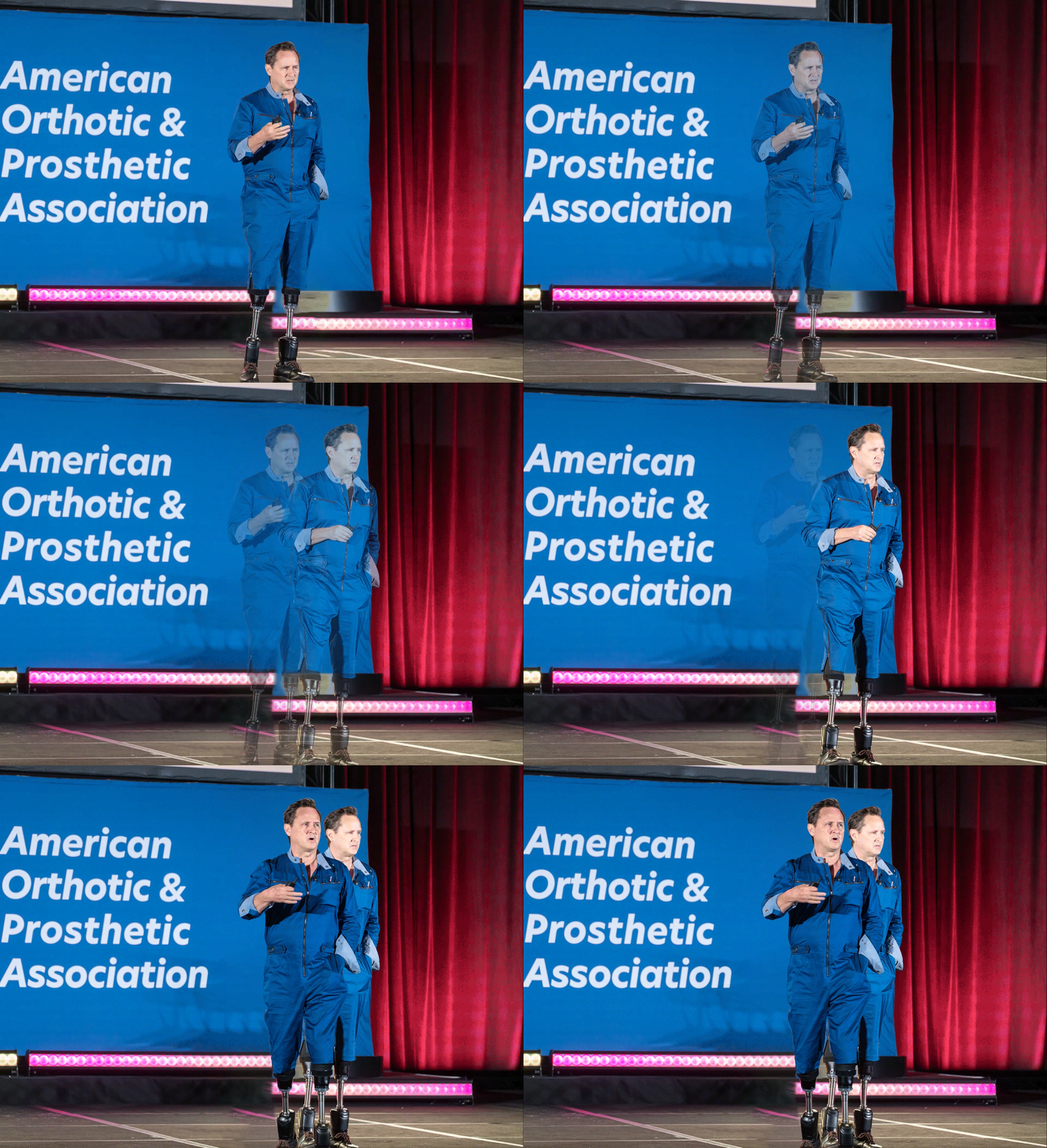
Image Caption: Hugh Herr, PhD, delivers the keynote address at the 2026 AOPA National Assembly
Could you give the current definition of “bionics”? I know I couldn’t. But double amputee Hugh Herr, PhD, succinctly describes it as a two-way exchange between biology and design. And he should know. After all, he’s been responsible for breakthrough advances in bionic limbs that provide greater mobility and new hope to individuals with limb loss or limb difference. (He’s also a professor of media arts and sciences at the MIT Media Lab and co-director of the K. Lisa Yang Center for Bionics at MIT.)
“In the modern era, designers are actually creating new biology that nature did not anticipate, through synthetic biology, protein engineering, surgical design, tissue engineering, and so forth,” he said. Later in the talk, he summed up the work this way: “We’re building new bodies, not new devices.”
Although bionics is not a new field, progress has accelerated recently because a number of science and engineering fields are converging at once. These include robotics, AI, material science, and more, according to Herr. The result is a Hollywood-style bionic era beginning to play out in real life—and one that is about to solve or dramatically mitigate historical clinical challenges in the profession.
And no, the machines aren’t taking over. In O&P, the story is shaping up to be far friendlier. Consider the following points Herr made during his opening keynote address at the 2026 AOPA National Assembly:
A fully neuromodulated interface. One critical goal for Herr and his team is improving the neural interface—connecting the brain to smart mechatronics. “In my case, that would mean that I can think and I can directly control the motors with my brain. And when I touch my artificial limb, it feels like I’m touching the skin of my arm, to achieve a bidirectionality between efferent and afferent,” Herr said.
Electromyographic (EMG) control has been the standard for decades in upper-limb devices. It uses electrical signals produced by skeletal muscles to operate prosthetic limbs or exoskeletons. But it also has problems. The system requires frequent recalibration because sweat and heavy loads change the signal over time. The electrodes also can be uncomfortable for the user.
At the Yang Center, Herr and his colleagues are exploring a new way to amputate, called the agonist-antagonist myoneural interface (AMI). The surgeon reconnects agonist-antagonist muscle pairs, which worked in opposition before the amputation, so that moving the phantom limb sends proprioceptive information, a sense of the limb’s position and movement, back to the brain. The muscle signals are decoded by a computer that controls the robotic limb.
“What’s unusual about this is all the control is from the person’s brain, not from an algorithm for the robot,” Herr explained. “The robot is just interpreting the neural signals.”
To read those muscle signals, the team uses magnetomicrometry—small magnetic beads implanted in the patient’s muscle and tracked by sensors outside the body. In early tests against surface and implanted EMG, the magnetomicrometry signal needed no filtering, and patients held their limb positions much better. Also notable for clinical care: The controller settings stay fixed. With magnets, “once you set the gains, you never have to touch it ever again,” while with EMG “you constantly have to set, adjust the gains, and fiddle with it,” said Herr.
To restore the sense of touch, the team also invented a new tissue construction called the cutaneous mechanoneural interface, or CMI. Surgeons move a patch of skin, along with its original nerve, into the residual limb and wrap it in muscle. When the robotic limb is touched, a computer signals the muscle to contract. The muscle stretches the skin patch, which activates its touch receptors, so the person feels the touch as if it were on their missing limb.
The team has now combined AMI, magnetomicrometry, and CMI in patients’ residual limbs to create a closed-loop, fully neuromodulated system.


(Left) Jim Ewing wearing a specialized robotic prosthesis, designed specifically for rock climbing by Emily Rogers, Matthew Carney, and Seong Ho Heung. Credit: MIT Media Lab/Biomechatronics group, Matthew Carney. (Right) When connected to an advanced prosthetic limb, the AMI enables natural reflexive behaviors when walking up and down stairs. Credit: MIT Media Lab/Biomechatronics group, Cameron Taylor.
Exoskeletons for all. For more than a century, exoskeletons have failed to improve normal walking. The turning point, according to Herr, happened in 2014, when his lab developed the “first fully autonomous wearable powered leg exoskeleton.” It’s essentially a robotic calf muscle that cut the energy cost of walking by 8%.
A decade of packaging and engineering work took that “very crude prototype” to a new level, and the market has shifted to consumers in the past four years, he said. Examples include footwear and apparel companies partnering with robotics firms, and a knee device built into outdoor clothing. Dephy, the bionic footwear company Herr co-founded, has partnered with Nike on Project Amplify, the world’s first powered footwear system for running and walking, according to its website.
Market indicators also are strong, said Herr, noting that a recent CES had 19 exoskeleton booths. Investment is up 7.5 times in one year, he said, and prices are falling. Exoskeletons that currently cost about $500 to $5,000 will fall below $1,000 soon, he predicted.
This presents the profession with an “extraordinary opportunity” by opening up large patient populations typically not seen in O&P clinics, including individuals with plantar fasciitis, osteoarthritis, fractures, or posterior tibial tendon dysfunction, Herr argued. “This is a non-exhaustive list of the conditions that people in the field believe will be positively impacted through these consumer devices.”
Science of comfort. Craft-based liner socket design has been the standard of care for millennia, said Herr. “But it’s still a paramount rehabilitation problem,” he explained, citing a 2025 study that found socket comfort is the strongest predictor of quality of life.
Herr sees an opening to advance the “science of comfort” by combining four fields: surface scans, MRI, and CT body imaging; soft-tissue modeling, which now includes sophisticated biomechanical models; computational design; and digital fabrication. His team starts with detailed data on the individual patient and uses it to build a biomechanical digital model of the residual limb. They then pair that model with the liner and socket materials, and a computer repeatedly adjusts the shape and mechanical properties of those materials to reduce loads on the body. The design is then digitally fabricated, and the result is a personalized, comfortable O&P interface.
A key outcome of this workflow for clinicians? A patient typically needs only a single CT scan for life, and a good fit stays good. Over the course of 15 years, the team developed an adaptive algorithm that solves for load distribution at each anatomical point. “We’ve quantified for each patient their load map, and we found that to be fairly invariant as the limb changes shape, for example, atrophies as they age,” he said. “When you solve fit on your patient, you will have always solved fit on that patient.”
First-time patients fit with his team’s workflow needed an average of 1.13 check-socket fittings, Herr reported. By comparison, a 2021 paper found that standard practice averages six appointments from first visit to delivery, often including multiple check-socket fittings.
Digital Augmentation Is the Future
Herr’s session circled back to an all-too-familiar topic: clinician shortages. The U.S. population of people with limb loss is growing, while new CPOs are being trained much more slowly. To accommodate growing caseloads, digital tools for measurement, design, fabrication, monitoring, and reimbursement support become critically important, he said. And the payoff is better outcomes and improvements on the human side of care. Clinicians would be able to give patients more effective treatment and have more time to spend with them, using their soft skills.
Patients with two-way, brain-connected limbs experience the limbs as their own body. Taking that concept further, Herr believes that if a person can embody a prosthesis, that person could also embody a whole humanoid robot. He also noted predictions that humanoid robots will outnumber humans within 10 to 20 years.
“The new era that we’re entering into, I believe, is a human-AI symbiosis,” he said. “I probably terrified people, but that’s where I see things broadly, and how P&O will deeply impact the broader world beyond assistance.”

Missed the keynote? Beginning September 28 through November 30 (please note the closing date has been extended to allow for flexibility around Thanksgiving), full-conference attendees can log into the virtual platform to watch sessions they missed or rewatch their favorites and earn additional CE credits. The platform tracks all sessions viewed, and AOPA will send monthly CE updates to ABC and BOC.
Subscribe

Stay sharp in 2026. Get the O&P insights that matter—news, clinical trends, and business strategies the best in the field are already using—delivered to your inbox. Sign up for the O&P Almanac newsletter.
